Siang Upper Multipurpose Project: What a Feasibility Survey Can Tell Us
Why Arunachal Pradesh’s proposed Siang dam is in the news, what a pre-feasibility survey examines, and how to assess hydropower, flood risk and local livelihoods.
GS I · river systems | GS III · infrastructure, environmental impact and disaster management
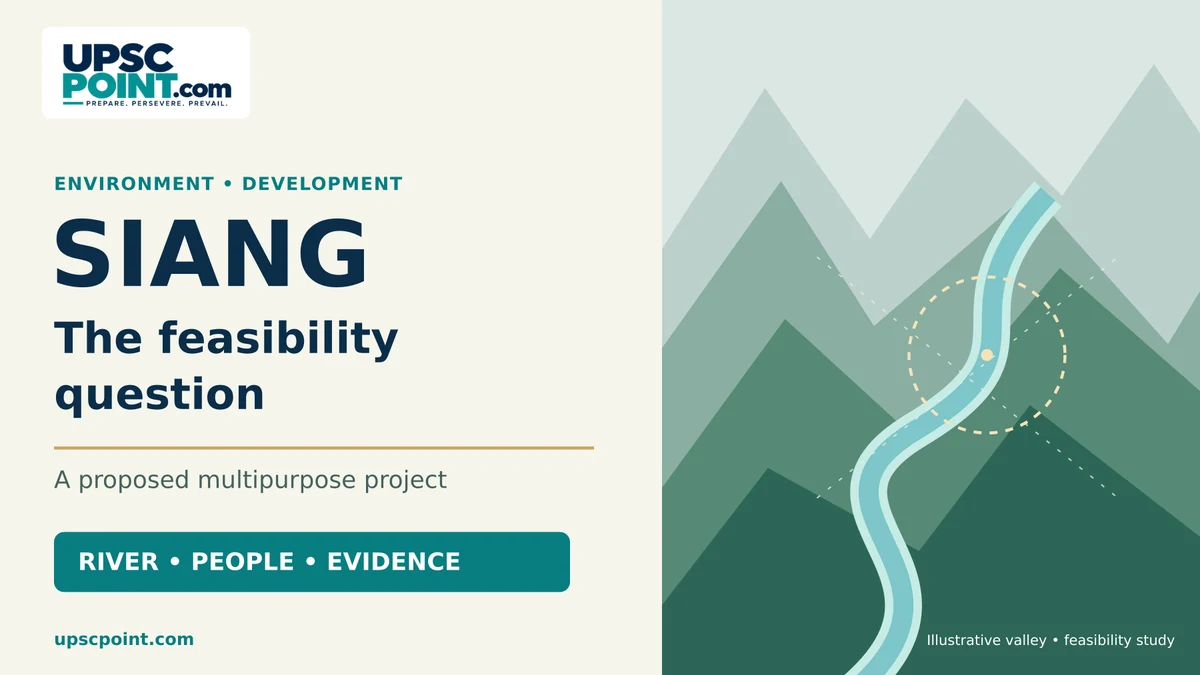
When officials announce surveys for a dam, what has actually been decided? For the proposed Siang Upper Multipurpose Project in Arunachal Pradesh, the state gazette authorised a committee to coordinate pre-feasibility surveys. It gives a mandate to investigate. The potential benefits and costs still have to be demonstrated. [1]
Explore this article Sections & revision ↓
Why the Siang project is in the news
On 21 November, Union Home Minister Amit Shah backed the proposed project and called for dialogue with people in the Siang region. Residents and indigenous communities have raised concerns. The state’s own notification gives the survey committee responsibilities for engagement with affected families and community representatives. [1][2]
Place the issue on a map. The Siang is the river that flows into Arunachal Pradesh from Tibet and contributes to the Brahmaputra downstream. A decision about storage in the upper valley therefore raises different questions for a riverside village near a proposed reservoir and a settlement much farther downstream. [2][3]
How engineers test a claimed benefit
For power generation, two inputs matter: how much water passes through the turbines and how far it falls. A proposed capacity in megawatts describes power. Energy delivered over time is measured in megawatt-hours. For example, a hypothetical 100 MW plant running at full output for two hours generates 200 MWh. The example makes no prediction for the Siang project.
Flood moderation raises a different question. Imagine a reservoir nearly full at the start of a storm. It has less space to absorb incoming water than it would at a lower starting level. An assessment should therefore test how release rules, forecasts, warning times and downstream safety work together. A headline storage or capacity figure answers none of those questions by itself.
What evidence would affected communities need?
A family whose access road could be submerged needs a map of the affected area, an alternative route and an opportunity to correct the survey record. A downstream fisher may need evidence about seasonal flows and sediment. These are illustrative examples of costs a regional power-generation total can hide.
A defensible Mains answer would compare alternative sites or operating rules, identify who gains and who bears risk, then explain how safety and livelihood claims could be checked. Specify which details still depend on surveys. The October gazette describes the committee’s survey and engagement functions. It does not report completed impact findings. [1]
Prelims practice on the pre-feasibility stage
Practice question: Which conclusion follows directly from a notification establishing a committee to coordinate pre-feasibility surveys for a proposed dam?
A. Construction approval has been granted. · B. The plant’s annual generation is known. · C. The state has put arrangements in place to coordinate preliminary investigations. · D. All affected households have accepted rehabilitation terms.
Answer C. The notification specifies who will oversee surveys and engagement. It does not certify generation, settlement of household claims or completion of the approval process. [1]
A framework to revise this issue
- 01Gather river and site data
- 02Document community uses
- 03Compare options and risks
- 04Use evidence in appraisal
| Concept or claim | What to examine |
|---|---|
| Installed capacity | MW measures power. Generation over a period is energy, measured in MWh. |
| Reservoir storage | Flood moderation also depends on available space, release decisions and warning time. |
| Pre-feasibility survey | Establishes evidence for evaluating options. Further appraisal and decisions follow. |
A question to think through
What evidence should guide the appraisal of a multipurpose dam in a Himalayan river basin? Illustrate with energy, flood risk and one local livelihood. (150 words)
Build a position, explain its mechanism, consider a counterargument and propose a workable response.
Sources & further reading
Sources provide the factual anchors. The arguments and proposed evaluation frameworks are editorial analysis; illustrative scenarios are hypothetical.
- Arunachal Pradesh Gazette, 1 October 2026 · Government notification on Siang pre-feasibility surveys ↗
- The Indian Express, 21–22 November 2026 · Siang project and the call for dialogue ↗
- Government of Arunachal Pradesh · Geography of Upper Siang district ↗
Found an error or a source that needs updating? Send the article title and the passage to our support team.