Ganga Water Treaty Explained: How Farakka’s Sharing Formula Works
How India and Bangladesh divide dry-season Ganga flows at Farakka, with a worked calculation, the low-flow exception and a UPSC Prelims question.
GS II · India and its neighbourhood | GS I · water resources
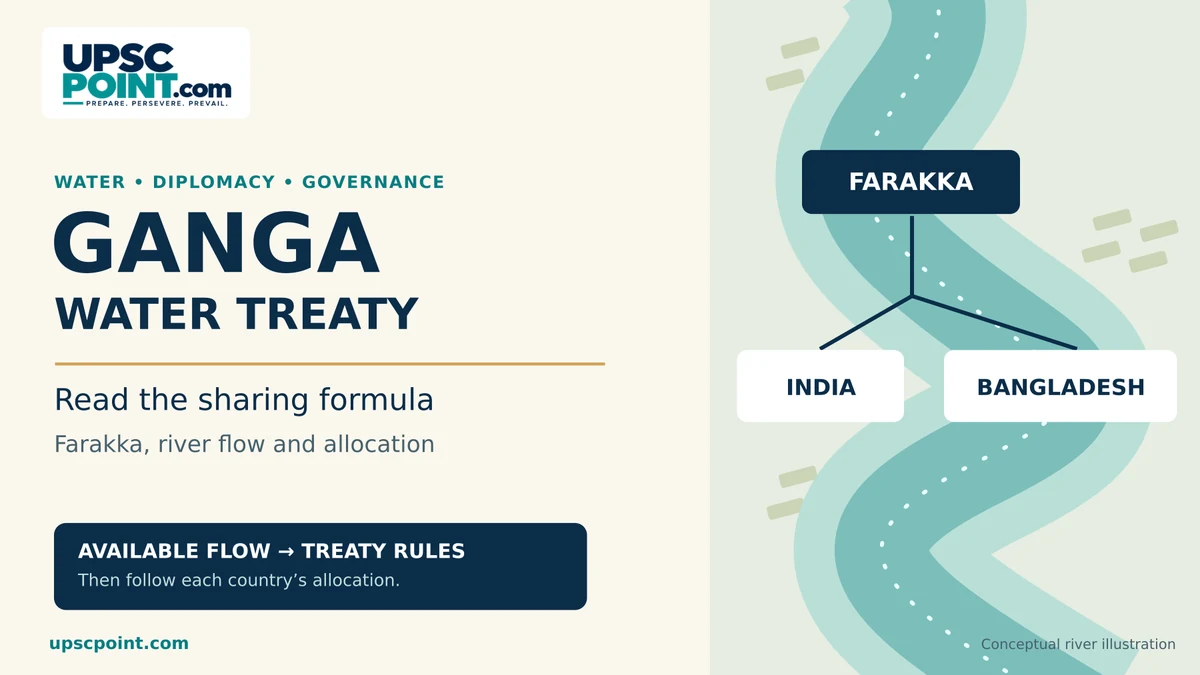
If 72,000 cusecs reach Farakka in early January, how much does Bangladesh receive? Under the 1996 Ganga Water Treaty, the answer is 35,000. Change the river flow or the time of year and the answer can change. The treaty gives the two countries a way to divide a resource whose supply varies. [1]
Explore this article Sections & revision ↓
Why Farakka is in the news
On 21 November, The Times of India reported that an Indian delegation had travelled to Bangladesh for a meeting of the committee that monitors water sharing. The distinction matters as the treaty approaches its thirtieth anniversary on 12 December 2026. The committee oversees implementation. Extending the treaty requires the two governments to agree. [1][2]
How to calculate each country’s share
Start with the location, the season and the unit. The treaty measures availability at Farakka in West Bengal. Its sharing rules cover ten-day periods from 1 January through 31 May. A cusec is one cubic foot per second, a rate of flow. The indicative schedule uses historical averages, so a number in that schedule is not a forecast for a particular January. [1]
Annexure I has three bands. Up to 70,000 cusecs, the basic split is equal. From 70,000 to 75,000, Bangladesh receives 35,000 and India the remainder. From 75,000 upwards, India receives 40,000 and Bangladesh the remainder. At the two boundaries, the adjacent rules give the same result. [1]
Try the middle band. With a hypothetical 72,000 cusecs available on 1–10 January, subtract Bangladesh’s 35,000 from 72,000. India receives 37,000. An equal split of 36,000 each would apply the wrong band.
What happens in a very dry period?
The base formula has two important qualifications. From 11 March to 10 May, each country is guaranteed 35,000 cusecs in three alternating ten-day periods. Separately, if availability drops below 50,000 cusecs in any ten-day period, the governments must consult immediately on emergency adjustments. [1]
The treaty provides for joint measurements at Farakka and Hardinge Bridge in Bangladesh. Shared measurements can settle a disagreement about how much water arrived. Deciding how exceptional scarcity should be shared is a second, political question. That distinction gives a Mains answer a mechanism as well as a principle. [1]
Prelims practice on the Farakka formula
Practice question: Suppose availability is 82,000 cusecs during 1–10 January. Under Annexure I, which shares follow?
A. India 41,000 and Bangladesh 41,000 · B. India 47,000 and Bangladesh 35,000 · C. India 40,000 and Bangladesh 42,000 · D. India 35,000 and Bangladesh 47,000
Answer C. At this level India’s share is 40,000. The remaining 42,000 goes to Bangladesh. January also puts this example outside the special March–May window. [1]
A framework to revise this issue
- 01Identify the ten-day period
- 02Measure flow at Farakka
- 03Apply the relevant band
- 04Check the low-flow provisions
| Concept or claim | What to examine |
|---|---|
| Allocation | Annexure I uses availability at Farakka to assign each country a share. |
| Implementation | Joint monitoring provides both governments with a record of measured flows. |
| Renewal | Article XII makes renewal dependent on mutual consent. |
A question to think through
How can a transboundary river agreement provide both predictability and flexibility in a dry year? Discuss with reference to the Ganga Water Treaty. (150 words)
Build a position, explain its mechanism, consider a counterargument and propose a workable response.
Sources & further reading
Sources provide the factual anchors. The arguments and proposed evaluation frameworks are editorial analysis; illustrative scenarios are hypothetical.
- India–Bangladesh treaty on sharing Ganga waters at Farakka, including Annexures I and II ↗
- The Times of India, 21 November 2026 · Indian delegation travels to Bangladesh for the water-sharing meeting ↗
Found an error or a source that needs updating? Send the article title and the passage to our support team.