Population Ageing in India: Public Systems for Dignity and Independence
Explore population ageing in India through pensions, accessible neighbourhoods, coordinated healthcare and long-term support that protects dignity and independence.
GS I: Population and social issues; GS II: Welfare and health

A pension that arrives regularly can still leave an older person housebound. A hospital that offers specialist treatment can still be unreachable without an escort. Population ageing asks a practical question of public policy: can someone continue to make ordinary choices when income, mobility or health changes? The answer depends on how institutions work together, not simply on how many schemes carry a senior-citizen label.
Explore this article Sections & revision ↓
Ageing is a change in needs, not one uniform condition
The category of older persons contains enormous differences. Someone who has retired with savings and secure housing faces a different situation from a seasonal worker with no predictable income. Chronological age is therefore a useful planning indicator but a poor substitute for understanding function, security and preference. WHO's ageing framework emphasises this diversity and the importance of environments that support people's abilities.[1]
Policy should avoid two opposite assumptions: that everyone above a threshold is dependent, and that family support will automatically meet every need. Both flatten individual lives. A better starting point is to ask which activities a person wants to maintain and what prevents them. That moves the discussion from charitable assistance towards meaningful independence and participation in everyday community life.
Read demographic evidence without losing its date
UNFPA's India Ageing Report 2023 examines institutional responses and draws substantially on the Longitudinal Ageing Study in India, conducted in 2017–18.[2] That distinction matters. A report's publication year is not necessarily the year in which every underlying observation was collected. An examination answer should identify the evidence's period rather than turning an older survey into a claim about this morning's conditions.
The most useful administrative question is often below the national level. Which settlements have older residents living alone? Where does travel make routine healthcare difficult? Which groups struggle with documentation? Local planning can combine population information with voluntary needs assessments, while protecting privacy. The aim is to locate gaps in service delivery, not to classify every older resident as a beneficiary who has lost the right to choose.
Income security must be reliable as well as adequate
A modest but predictable payment may support household budgeting more effectively than a nominally larger entitlement that arrives irregularly. Reliability reduces the need to borrow for routine expenses and limits dependence on intermediaries. Adequacy still matters: a payment that cannot cover meaningful essentials provides little protection. Both dimensions should therefore appear in any evaluation of pension support.
Consider a hypothetical woman who must travel twice to correct a bank detail before receiving her payment. The financial cost includes transport, but the larger burden may be uncertainty and the need to ask someone for assistance. Assisted correction, accessible grievance channels and clear payment records would address the actual problem. Digitising the application alone would not. Administrative simplicity is part of income security, rather than a separate technical concern.
Healthcare should follow the person across facilities
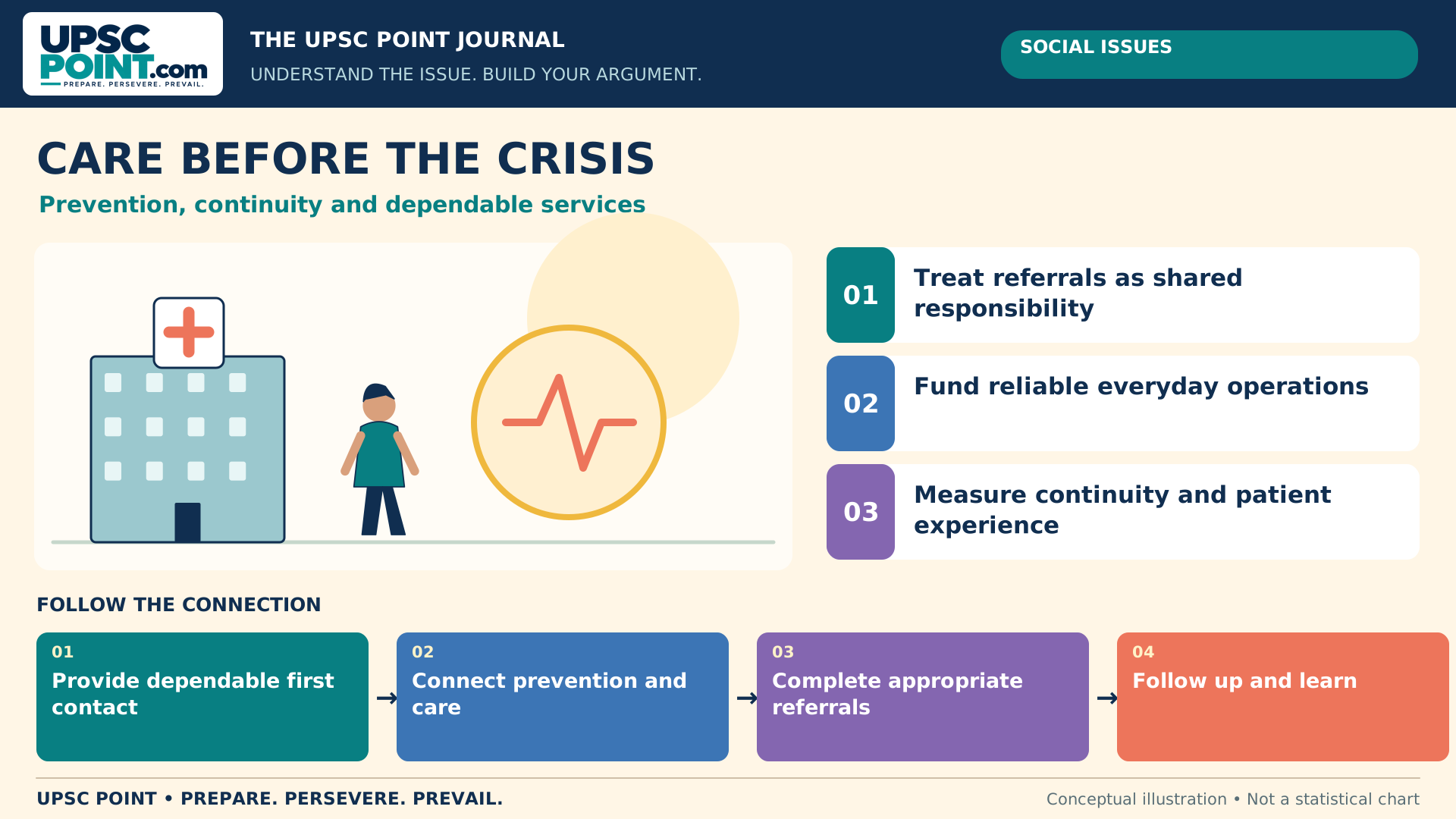
Older patients may need support from several services over time. When each clinic operates as an isolated episode, responsibility can disappear between consultation, referral and follow-up. A primary-care team that knows the patient's circumstances can help coordinate this journey. This is an institutional argument about continuity, not a recommendation about any individual's treatment or medication.
WHO includes person-centred integrated care and access to long-term care within its healthy-ageing agenda.[1] Applying that principle requires referral arrangements, usable records and a clear point of contact. It also requires recognising that travel, communication and waiting conditions affect access. A service advertised as free may remain expensive in practice if reaching it repeatedly consumes a household's time and income.
Long-term support needs standards and choice
Public debate often jumps directly from family care to residential institutions. There are other arrangements: support at home, daytime services, rehabilitation links and temporary assistance after illness. The appropriate mix depends on needs and preferences. The policy goal should be to expand trustworthy options, rather than make institutional residence the default measure of progress.
Services need standards for staffing, consent, complaints, safety and transparent charges. Public purchasing from private or voluntary providers may extend capacity, but contracts cannot replace oversight. A small provider should not be buried in paperwork, yet a vulnerable resident must have somewhere independent to report mistreatment. Quality assurance is credible when it examines actual experience and responds to failures, not just when an establishment holds a certificate.
Neighbourhood design can preserve daily autonomy
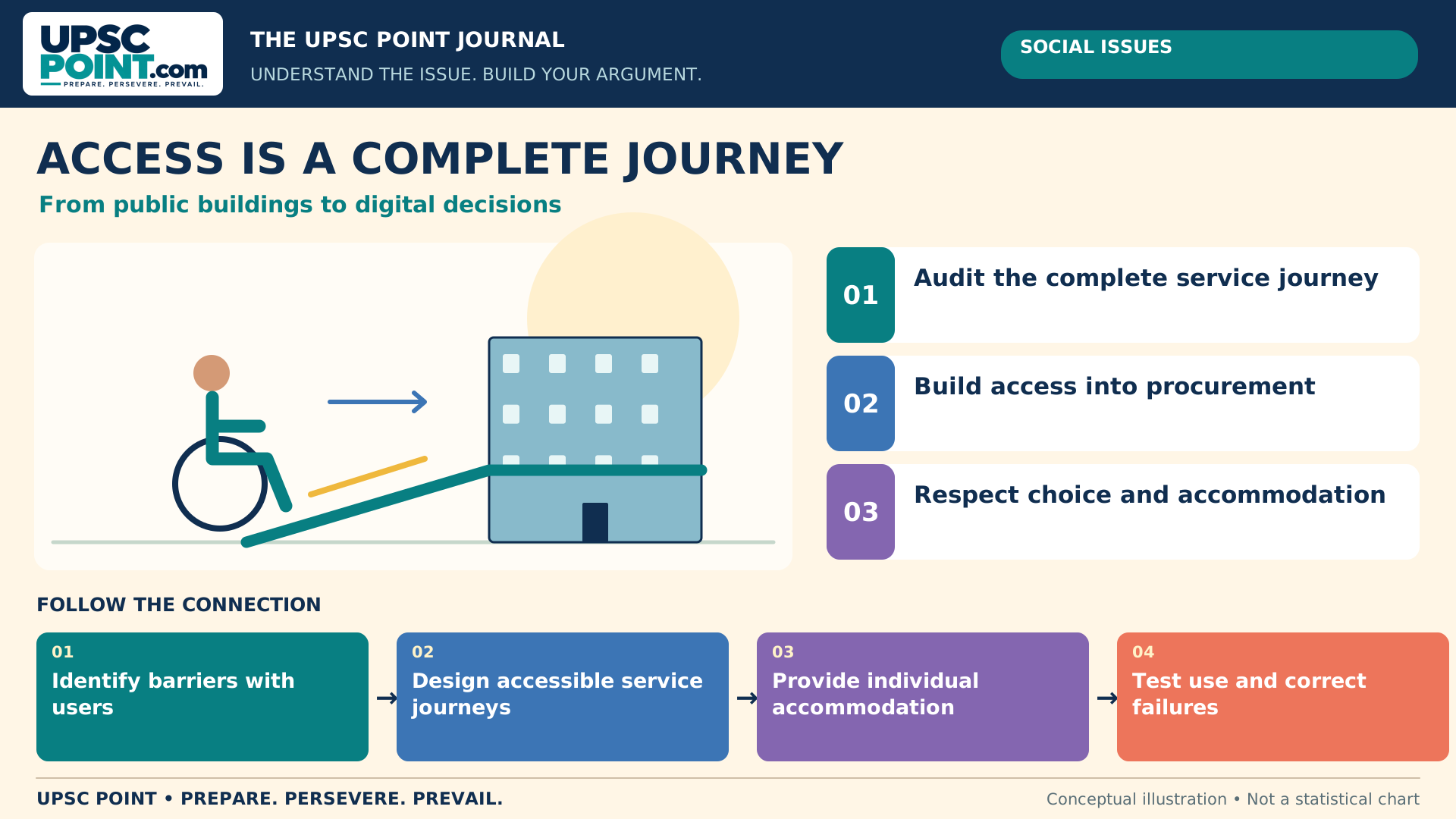
A broken pavement, a missing bench and a complicated bus interchange can jointly make a short outing impossible. These are not exclusively geriatric concerns. Improvements can benefit people with disabilities, parents accompanying children and anyone recovering from an injury. Age-friendly planning therefore belongs in ordinary transport and public-space decisions, not in an isolated annual campaign.
Imagine a market redevelopment that installs attractive lighting but removes resting places and shifts the bus stop farther away. Commercial activity may improve while access worsens for some residents. Consultation should test complete journeys: leaving home, crossing the road, reaching a service and returning safely. Small maintenance budgets can sometimes protect independence more effectively than a highly visible new building with poor connections.
Balance universal access with support for greater need
Universal public services can reduce stigma and make access easier to explain. Targeted assistance can direct scarce resources towards people facing the greatest constraints. Neither principle resolves every allocation problem. Narrow targeting may exclude someone whose documents misrepresent their circumstances; completely uniform provision may spend little where needs are especially intensive.
A workable combination is a dependable baseline available to everyone, with additional support assessed through transparent criteria and accessible appeals. Cost discussions should include what happens when support is absent: avoidable travel, interrupted care and pressure on emergency services. This does not mean every preventive investment will automatically save money. It means comparisons should examine consequences across institutions instead of treating one department's budget as the whole social cost.
Measure whether people can live the lives they value
Counting enrolled beneficiaries or facilities is necessary, but it cannot establish whether older people experience greater control. More revealing questions concern payment reliability, completed referrals, accessible transport, response to complaints and the ability to continue chosen activities. These measures should be disaggregated carefully, because aggregate improvement can coexist with persistent exclusion in remote or disadvantaged communities.
For UPSC analysis, ageing is best understood as a test of the social contract across the life course. People are not valuable only while earning wages. Public systems should respect accumulated contribution while protecting present rights and preferences. A credible way forward combines predictable income support, coordinated care, accountable long-term services and accessible neighbourhoods. Its success would be visible in ordinary freedom: the ability to travel, seek assistance and make decisions without unnecessary dependence.
A framework to revise this issue
- 01Understand individual needs
- 02Connect income and services
- 03Remove everyday barriers
- 04Review autonomy and dignity
| Concept or claim | What to examine |
|---|---|
| Age threshold | A planning category, not a complete needs assessment |
| Income support | Adequacy and payment reliability both matter |
| Long-term care | Choice requires standards and oversight |
A question to think through
Population ageing requires a shift from isolated welfare schemes to integrated systems that preserve independence. Discuss with reference to India. (250 words)
Build a position, explain its mechanism, consider a counterargument and propose a workable response.
Sources & further reading
Sources provide the factual anchors. The arguments and proposed evaluation frameworks are editorial analysis; illustrative scenarios are hypothetical.
Found an error or a source that needs updating? Send the article title and the passage to our support team.