Disability Inclusion in India: Making Public Services Truly Accessible
Understand disability inclusion through accessible transport, digital services, reasonable accommodation and accountability across the complete public-service journey.
GS II: Social justice, rights and governance

A public office can have a ramp and still be inaccessible. The appointment portal may reject a screen reader; the service counter may be too high; instructions may be impossible to understand. Disability inclusion is not achieved by adding one visible feature. It requires examining the entire route through which a person exercises a right, from finding information to receiving a decision and challenging an error.
Explore this article Sections & revision ↓
Start with the barrier, not a stereotype
Disability is often discussed as though the person alone contains the problem. An inclusion-based approach instead examines the interaction between individual requirements and the surrounding environment. A hearing impairment creates different obstacles in a silent written process and in a service that communicates only through shouted announcements. The design of the institution therefore changes the extent of exclusion.
This does not deny differences in impairment or the need for specialist support. It challenges the assumption that those differences justify inaccessible mainstream systems. People with disabilities are also students, workers, parents, voters and customers. Their access cannot be confined to a welfare counter. Every department should ask how its ordinary service functions for people whose communication, mobility or sensory requirements differ from an imagined standard user.
Accessibility reaches beyond buildings
Article 9 of the UN Convention on the Rights of Persons with Disabilities addresses access to the physical environment, transportation, information, communication and services open to the public.[1] That breadth is important. A building inspection alone cannot establish whether someone can obtain a certificate, use public transport or participate in a consultation.
Think of accessibility as a connected journey. Information must be discoverable, the route usable, the interaction understandable and the outcome available in an appropriate form. If one essential link fails, investment in the others may not deliver meaningful access. This is why procurement teams, transport planners, software vendors and frontline staff all have roles. Inclusion cannot remain the sole responsibility of a small specialist cell with no influence over purchasing or operations.
A hypothetical service journey exposes hidden exclusions
Imagine a student with a visual impairment applying for a scholarship. The website allows keyboard navigation, but an essential document is an image without readable text. The application then requires a visual-only verification step. Finally, an error can be corrected only by visiting an office during working hours. Three departments may each describe their own stage as successful while the student remains excluded.
A useful audit would follow this application from start to finish with users who encounter different barriers. Automated checks can identify some technical defects, but they cannot fully evaluate comprehension, practical effort or the availability of assistance. The purpose is not to manufacture a ceremonial consultation. It is to discover failures before they become reasons for denying someone a benefit, examination opportunity or public service.
Universal design and accommodation solve different problems
Universal design tries to make an environment usable by a wide range of people from the beginning. Clear navigation, readable text, step-free routes and multiple ways to receive information are examples of the approach. Designing these features early is usually more coherent than attaching disconnected fixes after a system has already excluded users.
Reasonable accommodation concerns adjustments needed in a particular situation. Even a well-designed mainstream service may not meet every person's requirements. Treating universal design as a reason to refuse individual adjustments would misunderstand both ideas. Institutions need a clear process to request assistance, assess it fairly and explain decisions. A person should not have to negotiate from scratch with each new employee whenever the same need arises.
Health inequity reveals the cost of institutional barriers
WHO's 2022 Global Report on Health Equity for Persons with Disabilities argues that poorer health outcomes are connected to unfair conditions and barriers, rather than being an inevitable consequence of disability.[2] This distinction prevents fatalism. If exclusion is produced partly by service design, transport, communication and attitudes, then institutions have practical responsibilities to change those conditions.
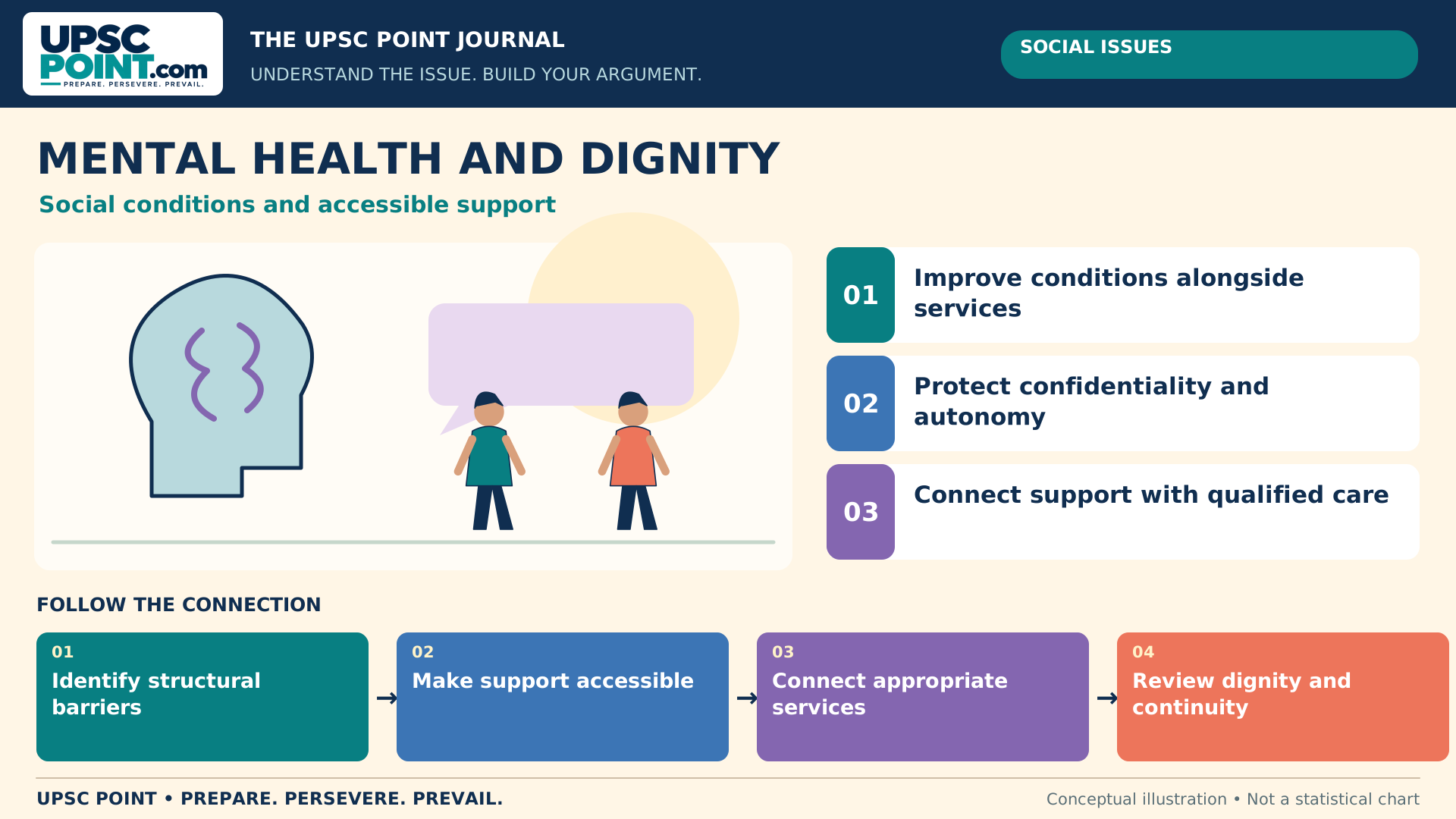
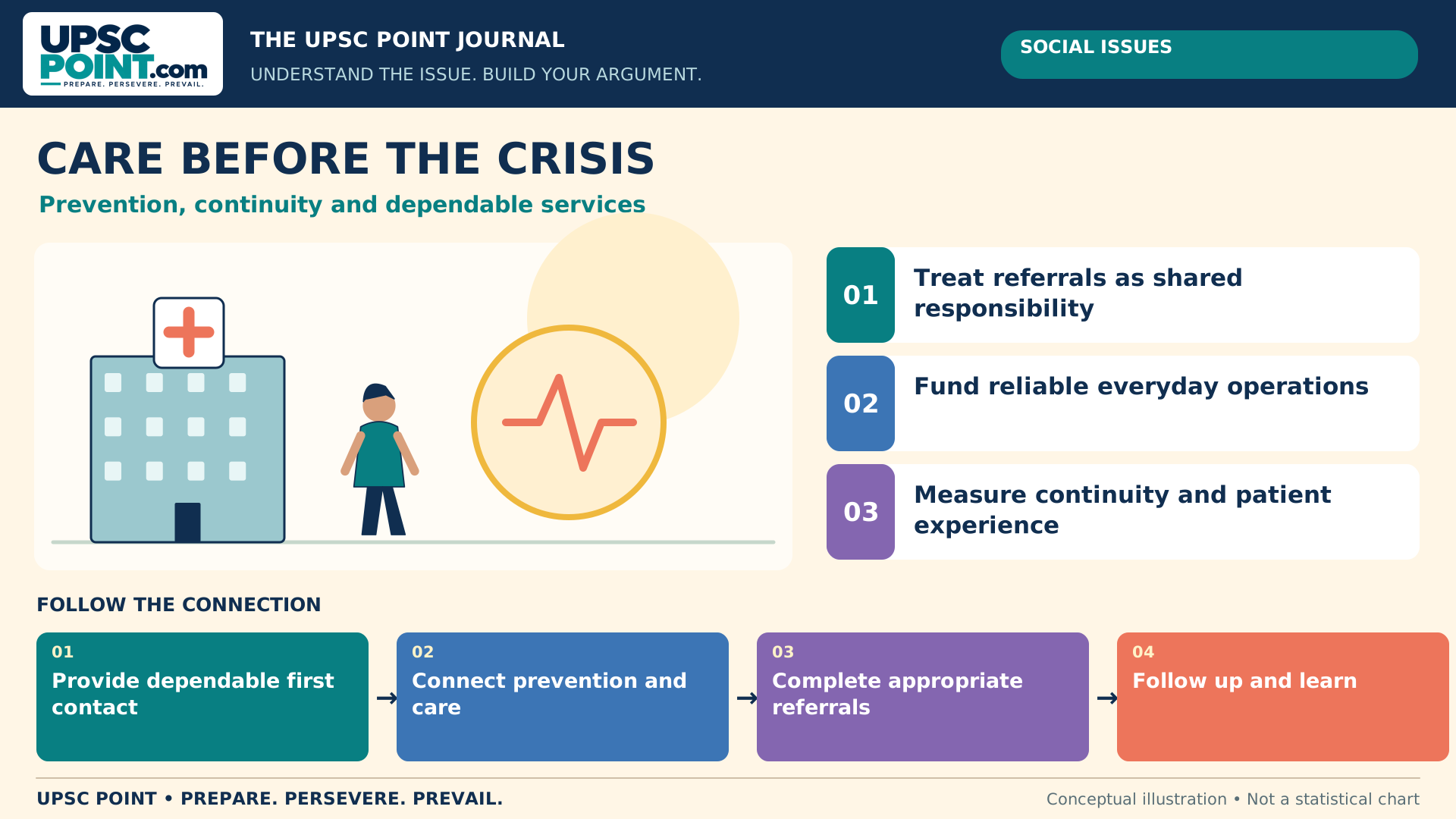
For a public-health planner, the question extends beyond the presence of a clinic. Can a person communicate privately, understand information and obtain follow-up without facing avoidable obstacles? Are support requirements recognised without removing autonomy? These are system-quality questions. They also show why accessible services benefit everyone: clearer explanations and easier navigation reduce mistakes for people who do not identify as disabled but face temporary or situational difficulties.
Procurement turns inclusion into an enforceable task
A general commitment to accessibility is weak if contracts reward only the cheapest initial delivery. Public purchasing should specify requirements that can be inspected, tested and maintained. Otherwise, a vendor can provide an impressive demonstration while leaving essential functions inaccessible. Responsibility should continue when software changes or a building is repaired.
There is a genuine capacity challenge here. Small local bodies may lack specialist staff, and highly technical tender documents can become a box-ticking exercise. Shared standards, reusable accessible components and independent testing support can reduce this burden. The answer is not to lower the expectation of access. It is to make compliance practical and verifiable, with acceptance tests tied to real tasks and clear responsibility for correcting defects.
Participation needs influence, not token representation
People with disabilities do not form a single group with identical priorities. A consultation involving one participant cannot stand for every experience. Institutions should seek varied perspectives and offer accessible ways to contribute. They should also compensate participation appropriately where possible, rather than expecting people to repeatedly provide specialist insight without recognition.
Participation becomes meaningful when feedback changes a decision and the institution explains what it did. Some requests may conflict with cost or technical constraints; those tensions should be discussed transparently rather than hidden behind claims that consultation occurred. A published account of identified barriers, planned corrections and unresolved issues creates a useful basis for accountability. It also allows future audits to test whether promises survived beyond the launch event.
Judge success by independent use and fair outcomes
An accessibility dashboard should measure more than installed ramps or compliant homepages. It should examine completed service journeys, correction times, accommodation requests and user-reported obstacles. Privacy matters: collecting disability-related information must have a clear purpose and safeguards. A service should not demand unnecessary disclosure merely to understand whether its general design works.
For a strong UPSC answer, connect rights, administrative capacity and everyday experience. The practical reform sequence is to audit complete journeys, fix high-impact barriers, embed requirements in procurement and establish accessible complaints. Disability inclusion is not a decorative addition to efficient governance. A process that works quickly only for a narrow group is incompletely designed. The standard should be whether different people can exercise the same rights with dignity and real agency.
A framework to revise this issue
- 01Identify barriers with users
- 02Design accessible service journeys
- 03Provide individual accommodation
- 04Test use and correct failures
| Concept or claim | What to examine |
|---|---|
| Accessibility | Mainstream environments must be usable |
| Accommodation | Individual adjustments may still be needed |
| Consultation | Participation should influence decisions |
A question to think through
Accessibility must be assessed across the complete public-service journey rather than through isolated infrastructure. Examine. (250 words)
Build a position, explain its mechanism, consider a counterargument and propose a workable response.
Sources & further reading
Sources provide the factual anchors. The arguments and proposed evaluation frameworks are editorial analysis; illustrative scenarios are hypothetical.
- United Nations: Convention on the Rights of Persons with Disabilities ↗
- WHO: Global report on health equity for persons with disabilities ↗
Found an error or a source that needs updating? Send the article title and the passage to our support team.