India’s Demographic Dividend: Skills, Health and Youth Capabilities
Explore India's demographic dividend through youth capabilities, quality apprenticeships, health, mobility and institutions that turn potential into opportunity.
GS I: Population; GS II: Human resources; GS III: Inclusive growth

A large working-age population creates a possibility, not a guaranteed economic reward. Young people need the capabilities to participate, adapt and make meaningful choices. That involves more than collecting certificates or filling vacancies. India's demographic-dividend debate is strongest when it examines the journey from childhood health and foundational learning to practical experience, mobility and continued development throughout working life.
Explore this article Sections & revision ↓
A demographic window is not an automatic dividend
UNFPA explains that a favourable age structure can support development when accompanied by investments in health, education, empowerment and decent work.[1] The distinction between a demographic opportunity and a realised dividend is essential. Population composition changes the conditions under which growth may occur; institutions and opportunities influence whether those conditions translate into wider prosperity.
This also means that national averages can hide different local timelines and constraints. Regions and communities may face different combinations of youth needs and ageing. Policy should not assume a single uniform window. Planning has to connect population structure with actual capability and demand, rather than use the language of a dividend as reassurance that growth will arrive simply because many people are young.
Capabilities are broader than a narrow job skill
A person may learn a specific procedure yet struggle when technology, workplace organisation or personal circumstances change. Foundational literacy, numeracy, communication and problem-solving support adaptation across tasks. Health, confidence and the ability to navigate institutions also affect whether a person can use what they know. These are complements to occupational skills, not substitutes for them.
The distinction helps explain why a short course cannot repair every earlier disadvantage. Training programmes should assess starting points and provide appropriate bridges rather than assume identical preparation. At the same time, capability language should not become vague enough to evade evaluation. Programmes need clear learning goals and credible assessments that show what a participant can actually do, including how they approach unfamiliar problems.
The transition into practice is an institutional gap
The move from learning to workplace experience can be difficult when employers require prior experience and learners lack a way to acquire it. Quality apprenticeships offer one possible bridge. The ILO's Quality Apprenticeships Recommendation, adopted in 2023, provides an international reference for structured learning and protection within apprenticeship systems.[2] It is a recommendation, not a claim that every domestic arrangement already meets its standards.
The key is that experience should include learning rather than merely inexpensive labour. Supervision, clear expectations, assessment and a credible qualification matter. Employers need workable arrangements, but participants also need protection and a meaningful progression route. An apprenticeship that repeatedly uses beginners for routine tasks without developing competence may improve an institution's placement figures while doing little to strengthen long-term capability.
A hypothetical graduate shows why access costs matter
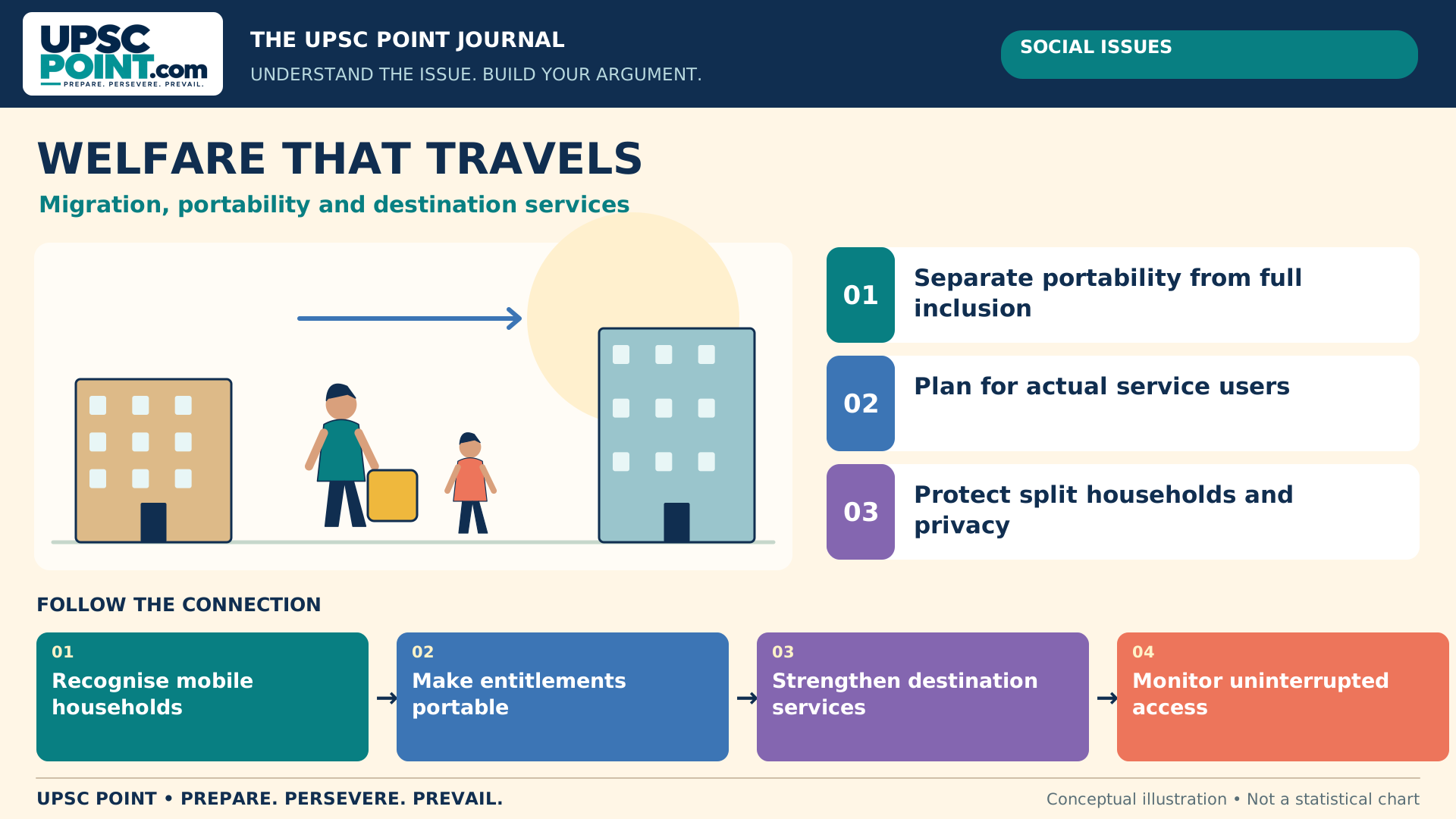
Imagine a young graduate offered a useful training opportunity in another city. The course itself is subsidised, but rent, transport and the delay before earning make attendance impossible. Another participant can accept because family resources cover these costs. Formally equal admission has produced unequal practical access, even before differences in confidence or networks enter the picture.
This example suggests that stipends, accessible accommodation, local provision or flexible formats may matter as much as adding seats. The best response depends on the actual barrier. A programme should not assume that low participation reflects lack of aspiration. Listening to those who decline or discontinue can reveal constraints hidden by data that tracks only enrolled participants and celebrates successful completion among those already able to attend.
Health and agency shape participation
UNFPA's demographic-dividend framework includes empowerment and the ability to make choices, particularly for women and girls.[1] This is not an optional social addition to an economic argument. If people face avoidable restrictions, violence or barriers to health services, the population's potential is not equally available for productive and fulfilling activity.
Policy should therefore examine safe mobility, accessible facilities and institutional rules that affect participation. It must also respect individual life choices rather than treating people only as instruments for a growth target. A demographic strategy should expand freedom, not pressure everyone towards one prescribed career or household pattern. The economic value of capability is important, but dignity provides an independent reason to invest in it.
Match training to changing demand without chasing every trend
Training systems need information about sectors and tasks, yet forecasts are uncertain. Overreacting to a fashionable technology can produce large cohorts with narrow credentials and limited opportunities. Conversely, teaching unchanged material indefinitely can leave learners poorly prepared. The challenge is to combine relevant occupational learning with transferable foundations and ways to update skills over time.
Employers can help identify practical needs, but public training should not serve only one company's immediate requirements. Skills that are too firm-specific may lose value when a contract ends or the worker moves. Partnerships should therefore clarify what competence is transferable and how assessment is recognised. Independent quality checks can help ensure that programmes develop capability rather than merely reproduce the language of the latest market trend.
Lifelong learning keeps the dividend from becoming a one-time bet
An initial qualification cannot cover an entire working life. Changing tools and responsibilities create a need for further learning, while interruptions can make re-entry difficult. Flexible pathways should allow people to build on existing competence rather than restart from the beginning whenever they seek a new role or return after a break.
Recognition of prior learning can help, provided assessment is credible. Experience alone does not automatically demonstrate every required skill, but dismissing it because it was gained informally also wastes capability. Institutions need ways to identify strengths and remaining gaps. The ILO apprenticeship framework's attention to inclusive pathways is relevant here.[2] A useful system values demonstrated competence while preserving standards and making additional learning realistically accessible.
Measure progression rather than certificates alone
Completion rates and certificates are necessary administrative measures, but they are not the final outcome. Evaluation should examine demonstrated learning, sustained participation, progression and the usefulness of acquired skills. It should also ask who was excluded before enrolment. A programme can report impressive success while serving mainly those who already had the resources to succeed.
For UPSC, the demographic dividend is best framed as a capability-building project across the life course. The practical priorities are stronger foundations, quality experience, accessible participation and continued learning, linked to a wider environment of opportunity. No training policy can substitute for that entire environment. The dividend becomes credible when young people can turn potential into durable choices, and when institutions remain accountable for the gap between announcing opportunity and making it usable.
A framework to revise this issue
- 01Invest in strong foundations
- 02Remove participation barriers
- 03Connect learning with experience
- 04Support lifelong progression
| Concept or claim | What to examine |
|---|---|
| Demographic window | An opportunity rather than a guaranteed gain |
| Training completion | A certificate does not establish lasting capability |
| Apprenticeship | Work experience should include structured learning |
A question to think through
Realising India’s demographic dividend requires investment in capabilities rather than an exclusive focus on training certificates. Discuss. (250 words)
Build a position, explain its mechanism, consider a counterargument and propose a workable response.
Sources & further reading
Sources provide the factual anchors. The arguments and proposed evaluation frameworks are editorial analysis; illustrative scenarios are hypothetical.
Found an error or a source that needs updating? Send the article title and the passage to our support team.