Mental Health in India: Social Determinants, Access and Dignity
Explore mental health as a public-policy issue shaped by social conditions, accessible services, confidentiality and institutional responsibility.
GS II: Health and social justice; GS IV: Empathy and dignity

A society cannot address mental health only by asking people to become more resilient. Conditions at school, at work, at home and in public institutions can either support well-being or make everyday life harder. At the same time, social reform cannot replace accessible professional care when it is needed. Serious policy must hold both ideas together without turning ordinary distress into a diagnosis or dismissing genuine illness as merely a social problem.
Explore this article Sections & revision ↓
Separate the policy question from individual diagnosis
Mental health policy concerns the conditions in which people live, the support they can access and the rights respected when they seek it. It should not encourage readers to diagnose themselves or others from a list of symptoms. Individual assessment and treatment require qualified professionals and attention to personal circumstances; this article examines institutions rather than offering medical advice.
WHO describes mental health as shaped by individual, social and structural determinants.[1] This framing avoids a false choice between personal experience and public policy. People respond differently to similar circumstances, but those circumstances still matter. An institution can reduce avoidable stress or discrimination without claiming to explain every person's mental health. The analytical task is to identify responsibilities that are realistic, evidence-informed and respectful of individual variation.
Social determinants explain unequal exposure to pressure
Insecurity, violence, exclusion and unstable living conditions can create pressures that cannot be resolved through motivational messages alone. The significance of these factors is not that they produce identical outcomes for everyone. It is that people have unequal exposure to adversity and unequal access to resources that help them manage it.
A policy response should therefore examine working conditions, housing, social protection and discrimination alongside health services. This does not mean every department must become a mental-health clinic. It means departments should recognise when their ordinary rules create avoidable uncertainty or humiliation. Predictable procedures, respectful communication and accessible grievance systems can improve institutional experience without pretending to replace specialist care or guarantee a particular health outcome.
Access includes time, trust and confidentiality
A service can exist geographically while remaining difficult to use. People may be unable to attend during available hours, fear disclosure or struggle to understand where to begin. Cost is important, but it is only one barrier. Privacy and respectful treatment influence whether someone feels able to ask for assistance in the first place.
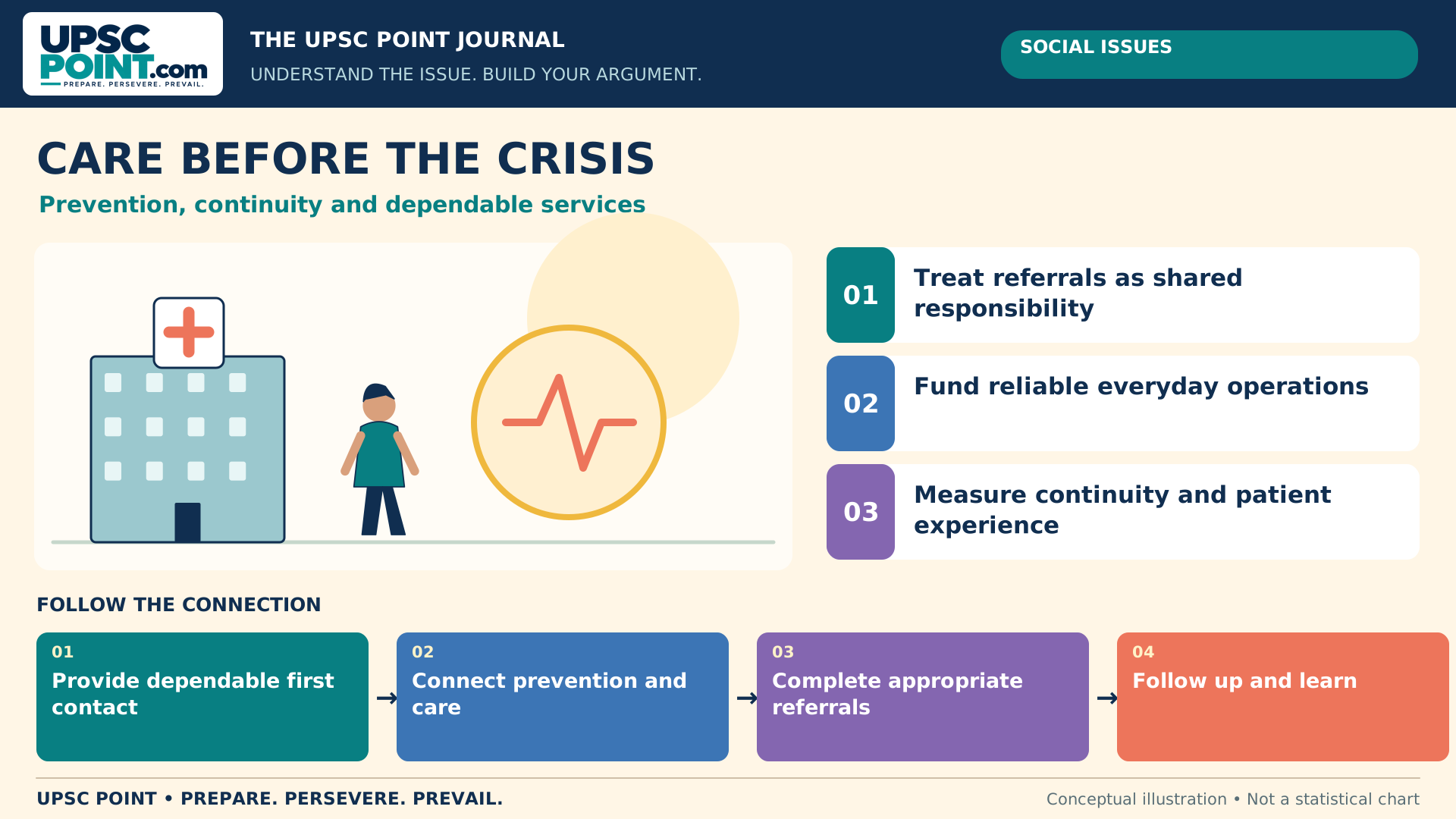
The WHO World Mental Health Report 2022 calls for transformation of both environments and systems of care.[2] For service design, this suggests a pathway that is understandable and connected, rather than a collection of disconnected telephone numbers and facilities. Institutions should explain what information is collected, who can access it and how referrals work. Confidentiality should be treated as an operational responsibility, not merely a reassuring sentence on a poster.
A hypothetical student illustrates institutional responsibility
Consider a student who faces repeated uncertainty about examination procedures, financial support and accommodation. An institution launches a well-being campaign but leaves contradictory deadlines and unanswered complaints unchanged. The campaign may be well intentioned, yet the organisation continues producing avoidable pressure through its own administration.
A more credible response would combine accessible professional support with predictable processes, fair assessment practices and clear information. This example does not establish the cause of any individual's condition. It shows that institutions can review their own contribution to difficult circumstances. Support becomes more trustworthy when it is accompanied by changes to harmful routines, rather than being offered as a way to help people tolerate preventable organisational failures indefinitely.
Community-based support needs professional connections
Support close to where people live can reduce barriers and make assistance less isolating. However, community involvement should not become an excuse to transfer complex responsibilities to untrained volunteers. Roles, supervision and referral arrangements must be clear. People should know when a service offers general support and when qualified clinical assessment is available.
WHO's 2022 report argues for strengthening systems of care and community-based approaches.[2] Applying that direction responsibly requires workforce development and dependable links across services. A local initiative may be valuable precisely because it helps someone navigate care, not because it claims to do everything itself. Quality depends on recognising limits as well as expanding reach, especially when a programme is promoted widely and expectations rise faster than capacity.
Awareness must avoid stigma and overpromising
Public communication can challenge stereotypes and explain that seeking help need not be a source of shame. But awareness campaigns can fail when they reduce complex experiences to slogans or imply that a simple habit will solve every problem. They can also encourage disclosure without ensuring that safe, appropriate support follows.
Messages should use respectful language and avoid portraying people only as vulnerable or incapable. Individuals retain agency, skills and relationships beyond any condition. Institutions should not use awareness initiatives to pressure employees or students into revealing private information. The aim is to make assistance accessible and discrimination unacceptable, while allowing people to decide what they share within the requirements of appropriate professional care and applicable safeguards.
Financing and accountability require careful measures
Counting consultations can show activity, but it cannot establish whether care was appropriate, accessible or respectful. A programme that prioritises volume may overlook continuity and follow-up. Evaluation should include service quality, waiting barriers, completed referrals and user experience, with safeguards that prevent sensitive information from becoming publicly identifiable.
There are difficult resource choices between specialist facilities, community services and wider prevention. They should be considered together rather than framed as an all-or-nothing contest. Social measures cannot eliminate every need for treatment, and clinical expansion cannot undo every harmful environment. A balanced budget should make responsibilities explicit and review unmet needs, instead of rewarding whichever intervention produces the most visible publicity or the easiest numerical target.
Build a humane system without making unsupported promises
The practical way forward is to improve entry points, clarify service pathways, strengthen professional capacity and make institutions examine their own practices. Schools, workplaces and public agencies can reduce avoidable uncertainty and discrimination while connecting people to appropriate support. Participation by people with lived experience should inform design without requiring anyone to turn private experiences into public testimony.
For UPSC preparation, mental health links health governance with dignity, equality and the social determinants of well-being. A strong answer avoids both individual blame and institutional overreach. It recognises that support must be available, competent and respectful, and that broader conditions deserve attention. The goal is not a society promising freedom from every difficulty; it is one where preventable barriers are reduced and people can seek assistance without losing their autonomy.
A framework to revise this issue
- 01Identify structural barriers
- 02Make support accessible
- 03Connect appropriate services
- 04Review dignity and continuity
| Concept or claim | What to examine |
|---|---|
| Social determinants | Conditions influence risks without determining every outcome |
| Awareness | Communication must connect to actual support |
| Community care | Accessible support needs supervision and referrals |
A question to think through
Mental health policy must address social determinants while strengthening accessible and rights-respecting services. Discuss. (250 words)
Build a position, explain its mechanism, consider a counterargument and propose a workable response.
Sources & further reading
Sources provide the factual anchors. The arguments and proposed evaluation frameworks are editorial analysis; illustrative scenarios are hypothetical.
Found an error or a source that needs updating? Send the article title and the passage to our support team.