India–China Relations: Managing the Border and Trade Dilemmas
Understand why border stability and trade dependence require different tools, and how India can reduce risks without confusing dialogue with agreement.
GS II · India and its neighbourhood; bilateral relations; GS III · economic security

A shipment can cross an ocean while two governments struggle to agree on what happens along a mountain frontier. That apparent contradiction is central to India–China relations. Economic contact and political trust do not always move together. Understanding the relationship means asking which risks trade creates, which risks border management addresses, and why neither can substitute for the other.
Explore this article Sections & revision ↓
A relationship with more than one clock
Border disputes move through negotiations, operational decisions and historical claims. Trade responds to prices, production networks and delivery schedules. A manufacturer may need an imported component this month even when diplomatic confidence is low. Treating every commercial transaction as evidence of strategic friendship therefore misunderstands how firms actually operate under constraints.
The Embassy of India’s account of political relations identifies the 1962 conflict as a major setback and the 1988 visit of Rajiv Gandhi as an important subsequent opening. Those dated landmarks show that relations have changed direction before. They do not establish that another improvement is inevitable, or that economic exchange resolves disagreements over territory. [1]
Separate a boundary settlement from border management
A boundary settlement concerns the agreed location and legal recognition of a border. Border management concerns the conduct of forces and officials while disagreements remain. Communication arrangements, restraint and agreed procedures can reduce immediate danger without settling sovereignty. Confusing these objectives encourages both exaggerated optimism after a meeting and exaggerated pessimism when a final settlement remains distant.
There is also a distinction between disengagement at a particular friction point and wider de-escalation. The first concerns immediate separation; the second involves a broader reduction in military tension or posture. A careful reader asks what geography, forces and activities an announcement covers. A limited operational step should be evaluated on its actual terms, rather than described as comprehensive normalisation.
Why communication matters without becoming a guarantee
During a confrontation, each side has incomplete information about the other’s intentions. Movement that one side regards as precautionary may look threatening to the other. Reliable channels help clarify events before assumptions harden into decisions. Their value is greatest when an incident is confusing, precisely when public debate often demands an immediate and categorical interpretation.
The 2014 India–China joint statement linked peace and tranquillity along the border with the development of bilateral relations. It is useful as a statement of the importance both governments then attached to stability, not proof that subsequent conduct always matched it. Agreements require implementation, verification and incentives for restraint; words alone cannot do that work. [2]
Read the trade problem at the level of inputs
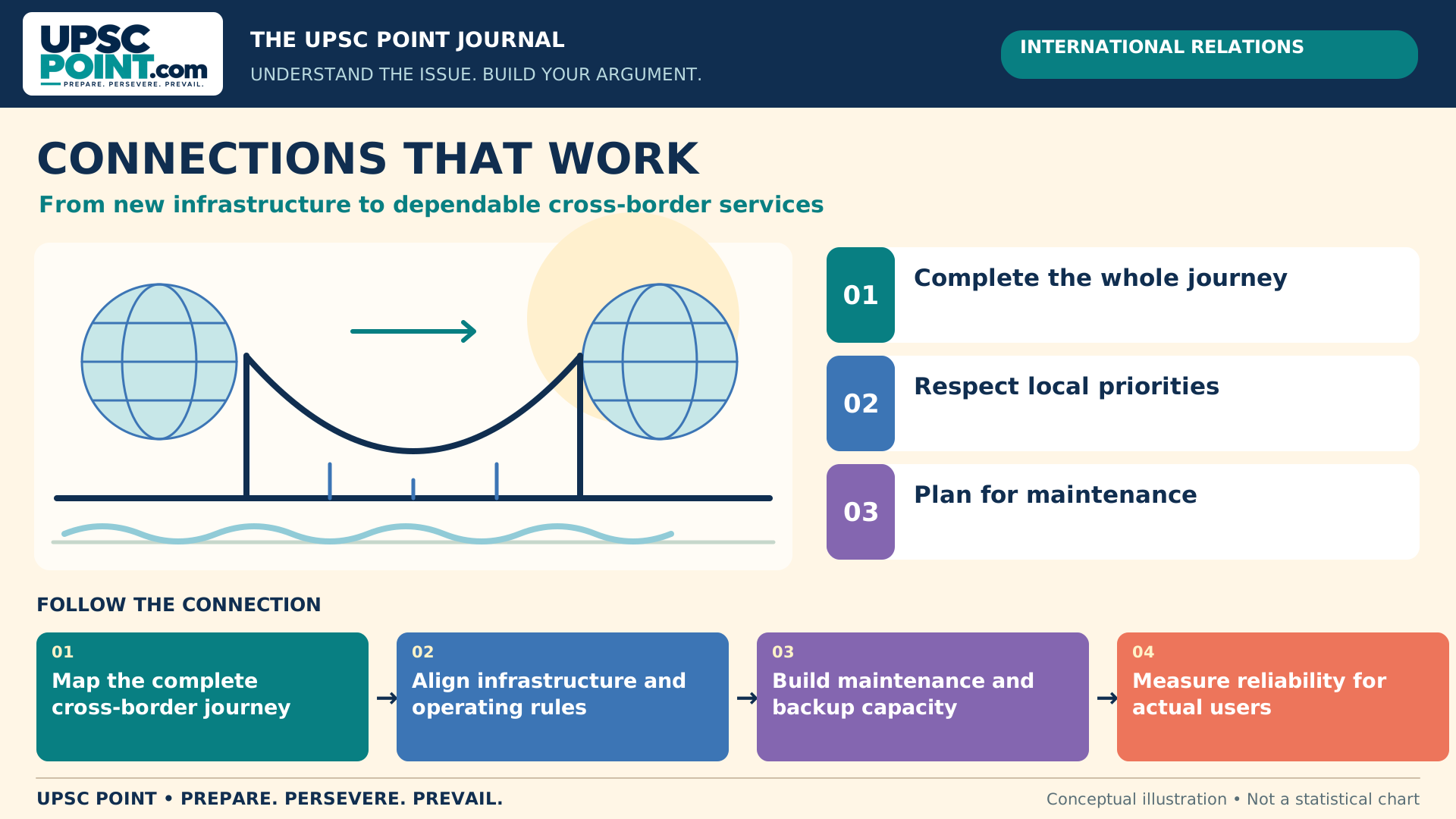
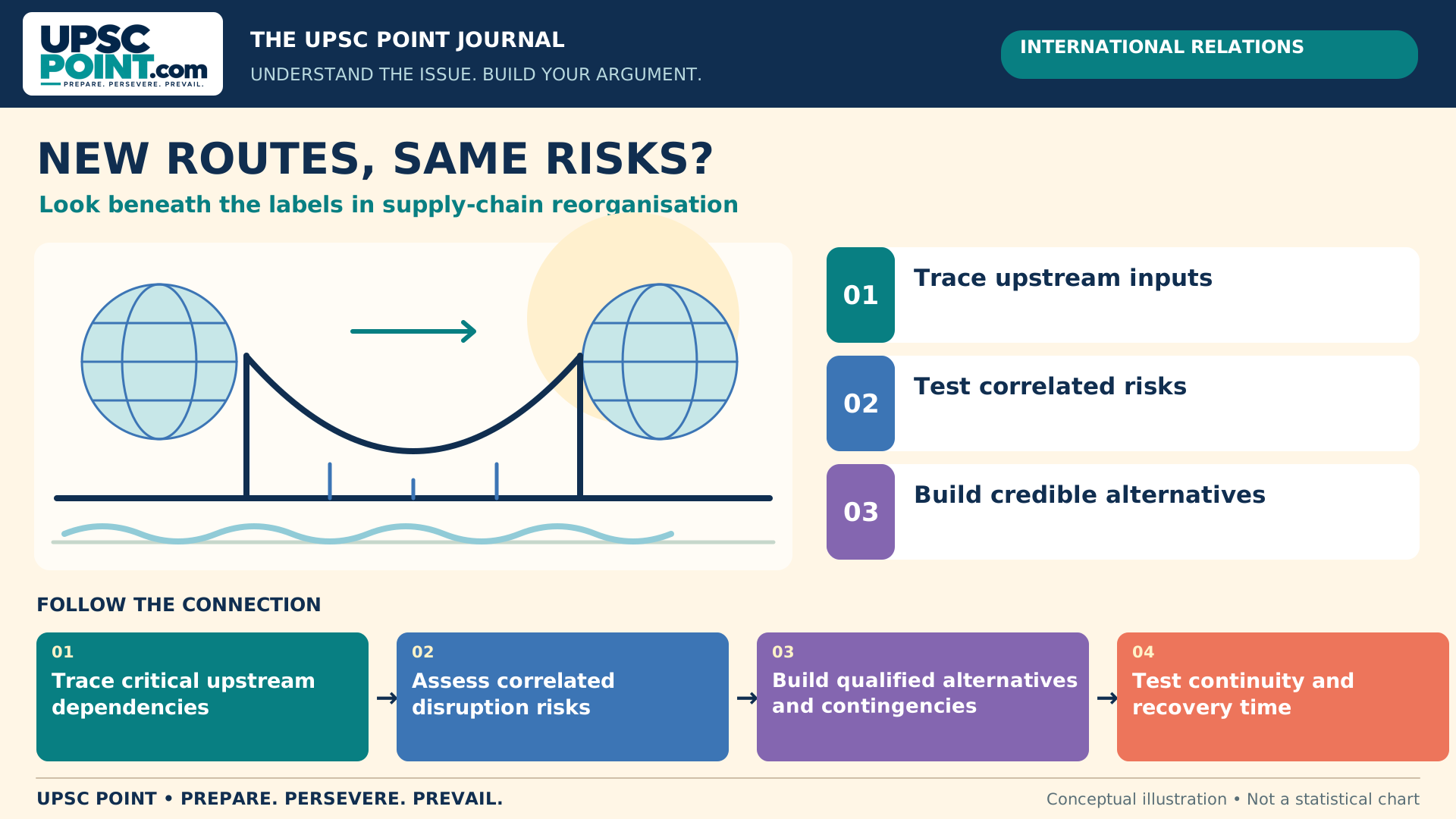
A bilateral trade deficit is a useful starting indicator, but it is not a complete map of vulnerability. Imported consumer goods, essential industrial components and easily replaceable commodities create different dependencies. The relevant questions are how concentrated suppliers are, whether substitutes meet quality requirements, and how quickly a disruption would affect production inside India.
Consider a hypothetical Indian medical-device manufacturer that buys a specialised sensor from one supplier abroad. A second supplier in another country may still obtain its crucial material from the first supplier’s region. Changing the invoice address would not eliminate the underlying dependence. Resilience requires tracing important layers of production rather than celebrating a superficial change in the country of final shipment.
Diversification has a cost that must be visible
Keeping alternative suppliers available may mean paying more, qualifying additional components and holding inventory. These costs can be justified where disruption would be especially damaging. But requiring every enterprise to duplicate every input would consume capital and raise prices, including for smaller businesses that cannot easily absorb expensive compliance or procurement arrangements.
The sensible question is not whether dependence should exist at all. All modern economies depend on external expertise, materials and markets. It is which dependencies are concentrated, difficult to replace and consequential enough to require public action. A risk-based approach can focus on critical bottlenecks while allowing ordinary commerce to benefit from competition and specialisation.
Domestic capability needs more than import restrictions
A restriction can create space for domestic production, but it does not automatically create an industrial ecosystem. Firms still need reliable electricity, skilled workers, testing facilities, finance and demand. If the missing component requires years of technical learning, a sudden barrier may damage downstream producers before a competitive domestic alternative becomes available.
Support should therefore be tied to capability milestones rather than indefinite protection. Examples include qualification of a domestic input, reductions in defect rates, or successful sales to demanding customers. Transparent review matters because a temporary strategic argument can otherwise become a permanent commercial privilege. Security policy should strengthen productive capacity rather than shelter avoidable inefficiency.
The dilemma of linking every issue together
Governments sometimes link progress in one area to behaviour in another to create bargaining pressure. That may signal seriousness, but broad linkage can also make cooperation on narrowly shared interests harder. If every technical conversation must await resolution of the most difficult dispute, even practical arrangements that reduce misunderstanding may become politically unavailable.
The opposite approach has limits as well. Completely insulating commerce from security can leave firms and policymakers unprepared for a sudden crisis. A workable balance requires explicit boundaries: which activities remain possible, which sectors require scrutiny, and what conditions could trigger restrictions. Predictability helps businesses plan without asking them to make foreign-policy judgments on their own.
Assess developments with a disciplined checklist
When reading a new announcement, identify the date, the issuing authority and the exact commitment. Distinguish a decision from an intention to discuss, and an agreed procedure from evidence of implementation. Compare the scope of an operational arrangement with the language used in headlines. These habits are especially useful in a relationship where a single meeting can generate sweeping interpretations.
For a UPSC answer, connect military risk, diplomacy and economic capability without forcing them into one slogan. India’s challenge is to preserve credible security, reduce concentrated industrial exposure and maintain channels that can prevent miscalculation. Success would be measured through more predictable conduct and stronger domestic options, not simply through a larger trade figure or a more reassuring photograph.
A practical sequence for risk reduction
Begin with a map of critical dependencies and border-management mechanisms, because policy cannot prioritise risks it has not defined. Follow with targeted supplier diversification, better technical capacity and reliable crisis communication. Review whether interventions actually shorten recovery time after a disruption. These steps are analytical recommendations, not claims about measures already completed by either government.
There is no single instrument that produces trust, industrial strength and territorial security at once. Negotiation, surveillance, commercial regulation and manufacturing policy each solve a different part of the problem. Keeping their purposes clear makes it easier to judge limited progress fairly while remaining alert to unresolved risks. That is more useful than alternating between promises of a breakthrough and predictions of permanent confrontation.
A framework to revise this issue
- 01Identify the security and supply risks
- 02Separate management from final settlement
- 03Build communication and alternative capacity
- 04Review actual conduct and recovery time
| Concept or claim | What to examine |
|---|---|
| Disengagement | Separation at specified friction points |
| Boundary settlement | Agreement on the boundary itself |
| Diversification | Additional viable sources, not new invoices |
A question to think through
Explain why border management and economic risk reduction require distinct but coordinated approaches in India–China relations. Answer in 250 words.
Build a position, explain its mechanism, consider a counterargument and propose a workable response.
Sources & further reading
Sources provide the factual anchors. The arguments and proposed evaluation frameworks are editorial analysis; illustrative scenarios are hypothetical.
Found an error or a source that needs updating? Send the article title and the passage to our support team.