Supply-Chain Fragmentation: Friendshoring and Real Resilience
Learn why friendshoring and supplier diversification are not the same, and how India can assess supply-chain risks without confusing new routes with resilience.
GS II · regional groupings and international cooperation; GS III · technology and economic resilience

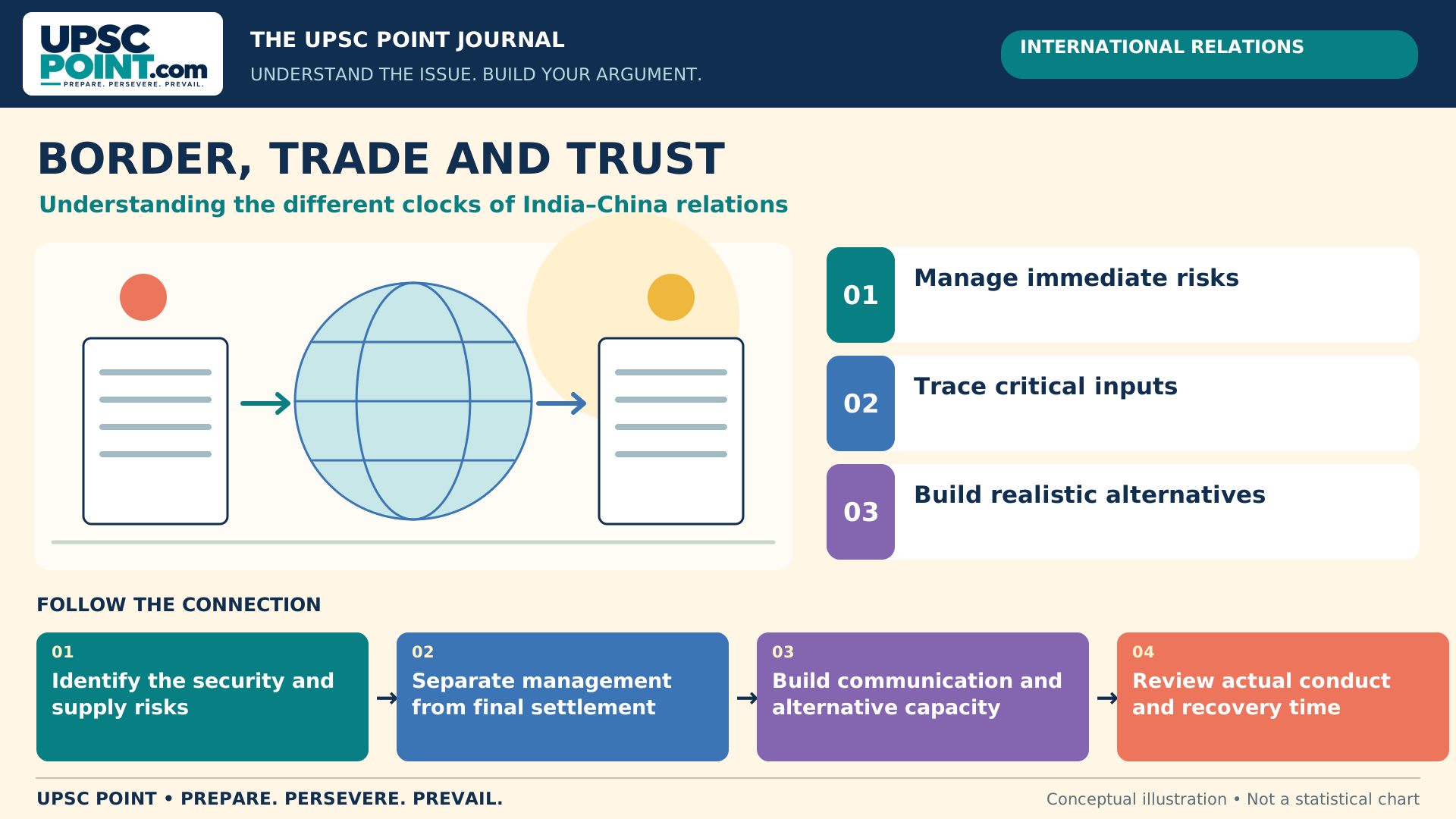
A company may announce that it has moved sourcing to another country while buying components that still depend on the same upstream factory. The map has changed, but the vulnerability has not. This is the central difficulty in debates about friendshoring: political distance, commercial location and genuine supply-chain resilience are related, but they are not interchangeable.
Explore this article Sections & revision ↓
Define the terms before judging the policy
Reshoring brings production back to the home economy. Nearshoring moves it closer geographically. Friendshoring directs activity towards countries considered politically dependable. Diversification spreads exposure across viable alternatives. These strategies can overlap, but each addresses a different concern. A nearby supplier may still be politically risky, while a politically friendly supplier may face the same physical disruption as the original one.
Fragmentation describes a broader weakening or redirection of economic links along geopolitical lines. It does not necessarily mean that international trade disappears. Trade may continue through different countries, firms or routes. Understanding that distinction is important because a change in bilateral trade figures can conceal continuity in the underlying production network.
Follow the component beyond the final exporter
An IMF working paper published in April 2024 examined changing global linkages and the role of connector economies. Its analysis cautioned that rerouting could support trade without necessarily eliminating strategic dependence. This is a research finding about the patterns studied, not a universal verdict on every new investment or supplier relationship. [1]
Consider a hypothetical battery assembler that shifts final assembly to a new country. If the critical processed material and production equipment still come from the original concentrated source, the move may reduce one exposure while preserving others. A meaningful risk assessment traces those layers. It asks what would stop production, not simply where the final product receives its shipping label.
Efficiency and resilience are different objectives
A highly efficient supply chain may minimise inventory and concentrate orders with the lowest-cost supplier. That can reduce prices in normal conditions but leave little room to absorb disruption. Resilience may require spare capacity, inventory or multiple qualified suppliers. These arrangements have a cost, which should be acknowledged rather than presented as a free improvement.
The appropriate balance depends on the product. A temporary delay in a non-essential decorative item has different consequences from a shortage of a critical medical or industrial input. Policy should prioritise concentration, substitutability and the damage caused by interruption. Applying the same resilience requirement to every product can waste resources and weaken the firms it is intended to protect.
Political alignment does not remove ordinary risk
Countries with close political relations can still experience earthquakes, floods, transport failures or domestic policy changes. Several friendly suppliers may also rely on the same port, energy source or upstream producer. Friendshoring can address some geopolitical concerns while leaving physical and commercial concentration largely unchanged. This is why resilience requires a portfolio view of risk.
A buyer should ask whether alternatives fail together. Two suppliers exposed to the same disruption provide less protection than their number suggests. This principle also applies within a country: moving production domestically does not guarantee continuity if all plants depend on one vulnerable input or corridor. The location of risk matters more than the comfort of a label.
The costs of broad separation need scrutiny
An IMF working paper on de-risking published in June 2024 modelled the economic consequences of large-scale reshoring and friendshoring. It found significant potential costs under its scenarios. Model results depend on assumptions and should not be treated as precise forecasts, but they highlight a basic trade-off: restricting access to efficient suppliers can reduce economic opportunity. [2]
Those costs may fall unevenly. Large firms can qualify alternatives and manage complex compliance, while smaller firms may struggle. Consumers may face higher prices, and developing economies can lose access to investment or technology. Security arguments can justify targeted action, but they do not remove the need to identify who pays and whether the intervention achieves its intended purpose.
India’s opportunity depends on capabilities
Supply-chain reorganisation can create openings for countries able to offer reliable production, skills and market access. India cannot capture every opportunity simply because firms want alternatives. Investors also examine logistics, power quality, contract predictability and the availability of suppliers. A competitive ecosystem develops through repeated commercial performance rather than a single announcement of interest.
The same applies to domestic value addition. Assembly can be an important starting point, but deeper capability requires design, components, quality assurance and technical learning. Policy should distinguish the value of attracting an initial operation from the challenge of expanding its local linkages. Both matter, but they should not be reported as if they were the same achievement.
Public support needs a clear exit and review
Subsidies or procurement commitments can help overcome coordination problems when several linked investments must occur together. They can also become expensive protection if performance is not assessed. Support should specify the capability being built and the evidence required to continue it. Otherwise, an argument about strategic necessity can shield firms from ordinary scrutiny indefinitely.
Useful milestones might concern reliability, technical qualification or the development of viable suppliers. A headline production figure alone may conceal dependence on imported inputs. Evaluation should also consider whether downstream firms become more competitive. Building one protected segment at the expense of many users may weaken the wider industrial system rather than strengthen it.
Businesses need information, not just instructions
Firms often lack visibility beyond their direct suppliers. Governments can help by improving information on critical dependencies and facilitating cooperation where individual firms cannot map a complex network alone. However, commercially sensitive data requires careful handling. The aim should be a practical picture of vulnerabilities, not indiscriminate disclosure that damages legitimate business interests.
Contingency planning should then identify how operations continue during disruption. Are alternative components already approved? Can transport be rerouted? How much inventory is useful? Plans should be exercised and updated because a supplier that existed on paper may not be available when everyone needs it simultaneously. Resilience becomes credible through preparation, not through a procurement policy’s name.
A better test is recovery time
The strongest question is how quickly a system can maintain or restore essential production after a defined shock. This shifts attention from symbolic relocation to operational performance. It also allows different solutions: diversified sourcing, inventory, repair capability or demand management may each be appropriate. Domestic production is one possible tool, not the only form of protection.
For UPSC, explain the distinction between geopolitical alignment and risk diversification, then connect it to industrial policy and development. Supply-chain resilience should preserve useful international exchange while reducing dangerous concentrations. A successful strategy creates credible alternatives and stronger capabilities without assuming that every foreign link is a weakness or every domestic link is automatically secure.
A framework to revise this issue
- 01Trace critical upstream dependencies
- 02Assess correlated disruption risks
- 03Build qualified alternatives and contingencies
- 04Test continuity and recovery time
| Concept or claim | What to examine |
|---|---|
| Friendshoring | Sourcing from politically aligned partners |
| Diversification | Spreading exposure across viable alternatives |
| Rerouting | Changing trade paths without necessarily changing inputs |
A question to think through
Distinguish friendshoring from supply-chain diversification. Discuss how India can pursue resilience while preserving competitiveness and productive international links. Answer in 250 words.
Build a position, explain its mechanism, consider a counterargument and propose a workable response.
Sources & further reading
Sources provide the factual anchors. The arguments and proposed evaluation frameworks are editorial analysis; illustrative scenarios are hypothetical.
- IMF Working Paper: Changing Global Linkages—A New Cold War?, April 2024 ↗
- IMF Working Paper: The Price of De-Risking, June 2024 ↗
Found an error or a source that needs updating? Send the article title and the passage to our support team.