India–Nepal Connectivity: Interdependence Without Dependence
Understand how transport, trade and electricity links can benefit India and Nepal, and why reliability, local participation and fair rules shape their value.
GS II · India and its neighbourhood; bilateral relations; GS III · infrastructure and environment

A new road can shorten a journey without making a border crossing predictable. A transmission line can exist without a buyer who knows when electricity will arrive. Connectivity between India and Nepal must be judged through these ordinary experiences. Infrastructure creates a possibility; institutions, maintenance and commercial arrangements determine whether that possibility becomes a dependable service.
Explore this article Sections & revision ↓
Geography creates opportunities and asymmetries
Nepal’s landlocked location makes access to transport routes especially important. India offers connections to larger markets and maritime trade, while cross-border links can also support Indian businesses and neighbouring communities. The relationship is interdependent, but the size and range of alternatives available to each country are not identical. Recognising that asymmetry is necessary for a credible account of cooperation.
The Embassy of India in Kathmandu describes bilateral relations as involving more than forty institutional mechanisms and development cooperation across several sectors. The important point is not the number alone. It is that a dense relationship requires regular coordination across technical agencies rather than occasional political meetings carrying the entire burden of cooperation. [1]
Distinguish a corridor from a complete journey
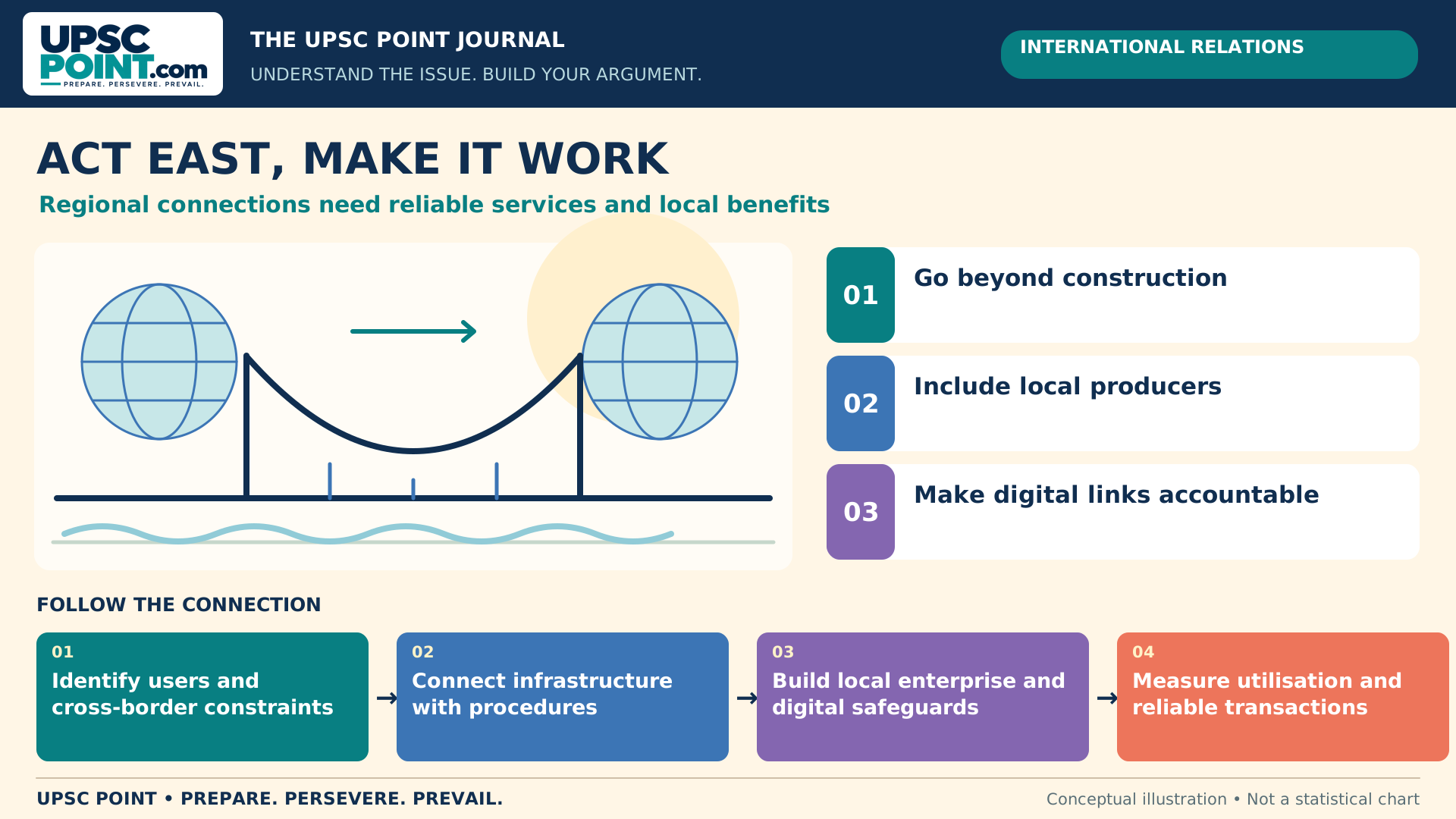
A transport corridor is useful when the different parts of the journey work together. A high-quality road ending at a congested checkpoint may save little time overall. Similarly, a rail link without adequate storage or connections to production centres may carry less traffic than expected. Planning should begin with the movement of actual goods and people, not with the visibility of an individual asset.
Imagine a hypothetical Nepali food processor exporting packaged produce. The road is improved, but inconsistent inspection times make delivery dates unreliable. Buyers then demand a price discount or choose another supplier. The binding constraint is administrative uncertainty rather than road quality. A customer-centred assessment would measure the full delivery time and its variation, not simply kilometres constructed.
Rules are a form of infrastructure
The Indian embassy’s commerce brief identifies bilateral treaties and agreements as part of the framework governing trade and transit. These legal and administrative arrangements are the less visible infrastructure of connectivity. They define what traders may do, which documents are required and how disputes or irregularities should be addressed. [2]
Predictable procedures reduce the need for personal contacts and intermediaries. That can particularly benefit smaller firms, which lack the staff to navigate changing requirements. Digitisation may help, but only if systems are compatible and users can correct errors. Replacing a paper queue with an unexplained online rejection is not a meaningful improvement in trade facilitation.
Electricity trade requires more than transmission capacity
Cross-border electricity links can connect generation and demand that differ across seasons and locations. Their usefulness depends on purchase arrangements, scheduling, grid stability and payment reliability. A physical line is therefore only one element of the commercial system. Investors need confidence that electricity can be sold under understandable conditions over a realistic period.
There are also domestic choices about how generation projects are developed and how benefits are shared. Communities may face land acquisition, environmental change or disruption during construction. Export revenue does not automatically compensate those costs. Transparent project appraisal and local participation help prevent a nationally celebrated project from becoming a source of persistent local resentment.
Interdependence works best when alternatives remain credible
Dependence becomes politically sensitive when one side believes its essential access can be interrupted without meaningful recourse. Diversifying routes or partners may therefore be understood as a search for resilience rather than an inherently hostile act. A confident partnership can accommodate reasonable diversification while making its own connections more efficient and trustworthy.
For India, reliability can be a stronger source of influence than insisting on exclusivity. For Nepal, diversification should be assessed through cost, feasibility and operational value rather than symbolism alone. The analytical question is whether an additional route genuinely increases options during disruption, and whether its financial and environmental costs are justified by the benefits it provides.
Local communities experience the border differently
Border regions contain social and economic relationships that do not fit neatly into national policy categories. Daily travel, family ties and small-scale commerce can be central to livelihoods. Security controls remain important, but their design should account for how legitimate users actually move. A rule that is easy for a large company may be difficult for a small trader to understand or satisfy.
Consultation can reveal these differences before a policy creates avoidable hardship. Authorities should distinguish ordinary administrative errors from deliberate wrongdoing and provide accessible ways to correct mistakes. This is not an argument for abandoning enforcement. It is an argument for enforcement that is proportionate, comprehensible and capable of maintaining public cooperation rather than generating routine distrust.
Maintenance is a diplomatic issue too
Infrastructure announcements attract attention, whereas maintenance rarely does. Yet a bridge that repeatedly closes or a checkpoint whose systems often fail can damage confidence in the partnership. The reputation of a project is built through its daily performance. Long-term budgets, spare parts, trained staff and clear ownership of repairs belong in the original design.
Disaster resilience matters as well. Projects should consider how traffic or electricity will be rerouted when an asset is unavailable. A single impressive connection can still leave users vulnerable if there is no backup. Connectivity planning should therefore include service continuity and recovery arrangements, rather than assuming that completing construction is the same as completing the task.
Sovereignty concerns cannot be dismissed as misunderstanding
Smaller states may scrutinise external projects because infrastructure can shape future choices. Questions about financing, ownership, access and standards are legitimate. Responding only with claims of goodwill leaves those questions unanswered. Publishing clear terms and explaining decision-making arrangements can do more for trust than asking the public to accept assurances without evidence.
At the same time, sovereignty is strengthened by the capacity to make informed choices, not by rejecting every external connection. Domestic institutions need the expertise to assess contracts, negotiate conditions and monitor performance. A partnership becomes healthier when both sides can explain why a project serves their interests and how disagreements will be handled without threatening the wider relationship.
Measure the relationship through reliability
Useful indicators include predictable journey times, fewer unnecessary procedural delays, dependable electricity transactions and the speed with which operational complaints are resolved. These measures focus attention on the service provided rather than the ceremony surrounding it. They also make it possible to identify whether a problem lies in infrastructure, regulation, maintenance or commercial coordination.
In a UPSC answer, connect geography with institutions and local political economy. India–Nepal connectivity offers gains when it expands practical choices and reduces uncertainty for ordinary users. The strongest partnership is not the one that announces the most projects. It is the one that turns agreed projects into reliable services while respecting Nepal’s agency and recognising the legitimate interests of both countries.
A framework to revise this issue
- 01Map the complete cross-border journey
- 02Align infrastructure and operating rules
- 03Build maintenance and backup capacity
- 04Measure reliability for actual users
| Concept or claim | What to examine |
|---|---|
| Physical connectivity | Roads, railways and transmission assets |
| Institutional connectivity | Rules, approvals and interoperable procedures |
| Resilience | Ability to continue or recover during disruption |
A question to think through
Examine how India–Nepal connectivity can strengthen interdependence while addressing asymmetry, local concerns and operational reliability. Answer in 250 words.
Build a position, explain its mechanism, consider a counterargument and propose a workable response.
Sources & further reading
Sources provide the factual anchors. The arguments and proposed evaluation frameworks are editorial analysis; illustrative scenarios are hypothetical.
- Embassy of India, Kathmandu: Bilateral relations ↗
- Embassy of India, Kathmandu: Commerce wing brief ↗
Found an error or a source that needs updating? Send the article title and the passage to our support team.