India–ASEAN Relations: Making Act East Connectivity Work
Analyse Act East through transport, digital links and trade procedures, and see why usable regional connections require more than infrastructure announcements.
GS II · bilateral and regional relations; GS III · economic development and infrastructure

A regional connection is only as useful as the transaction it makes possible. Can a small enterprise deliver on time? Can a traveller understand the requirements? Can a digital payment cross systems safely? India–ASEAN cooperation becomes easier to assess when the discussion moves from lines on a map to the practical conditions under which people use them.
Explore this article Sections & revision ↓
ASEAN is a region of different economies
ASEAN should not be treated as a single country with one commercial structure or one strategic outlook. Its members differ in size, income, production networks and geography. India’s engagement therefore operates at two levels: cooperation with the regional institution and relationships with individual members. A policy that works well in one market may need substantial adaptation elsewhere.
The chairman’s statement of the 21st ASEAN–India Summit, held on 10 October 2024, situated cooperation within wider regional connectivity and resilience objectives. This is a useful dated anchor for the agenda. It does not demonstrate that every proposed connection is operational or that all members attach identical priorities to the partnership. [1]
Act East needs an implementation map
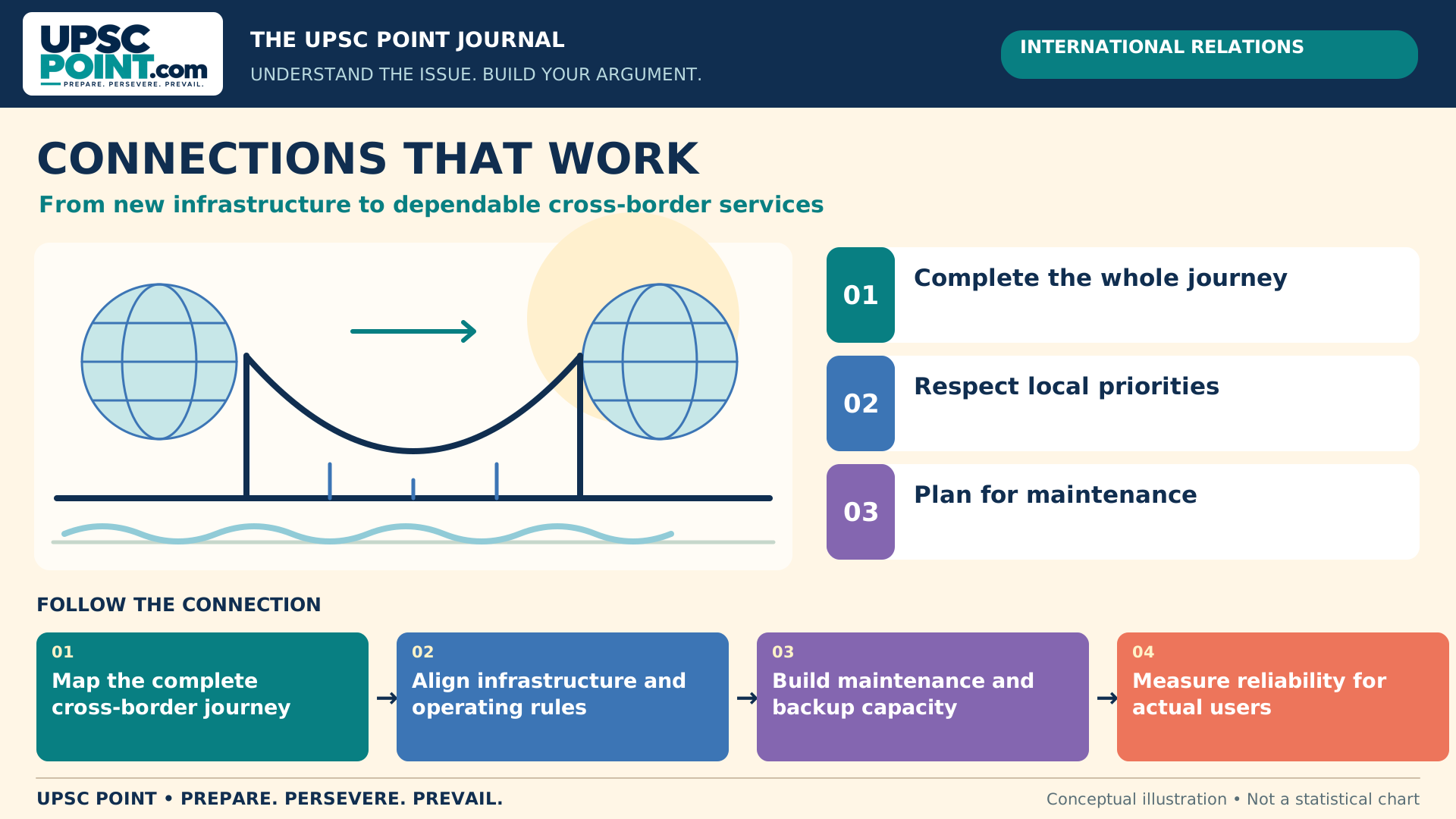
A policy direction identifies where greater engagement is desirable. Implementation requires identifying the agencies, financing, permissions and operating arrangements that turn that direction into activity. A highway, shipping service or digital link may involve several jurisdictions. Delays in one part can reduce the value of the entire connection, even when other parts are complete.
A clear implementation map should distinguish construction from operation and operation from meaningful use. A route can be technically open but commercially unattractive because schedules are unreliable or procedures costly. Measuring completion alone can therefore produce a flattering but incomplete picture. The relevant test is whether the connection creates a better option for its intended users.
Northeast India is more than a transit space
India’s northeastern region is often described as a gateway to Southeast Asia. That description can be useful, but it risks overlooking the region’s own development needs. A corridor that moves goods through an area without supporting local production or employment may produce limited benefits for residents. Connectivity should create local economic opportunities, not merely shorten someone else’s journey.
Consider a hypothetical producer of processed agricultural goods who lives near a new route. The road helps only if the producer can access testing, storage, packaging and buyers. Without those complementary services, larger firms elsewhere may capture most of the gains. Regional policy should therefore connect infrastructure planning with enterprise development and skills rather than assuming benefits will spread automatically.
Border procedures determine commercial reliability
Goods crossing jurisdictions encounter documentation, inspections and standards requirements. These can protect legitimate public interests, but duplication and unpredictability impose costs. A trader needs to know not only the average clearance time but also the likelihood of a serious delay. Uncertainty makes it harder to promise delivery dates and raises the amount of working capital required.
Coordination can focus on practical improvements such as clearer information, compatible documentation and risk-based checks. It should also preserve accessible alternatives for users who struggle with digital systems. A fully online process is not automatically inclusive if errors are difficult to correct or assistance is unavailable. Good facilitation makes compliance easier to understand without abandoning necessary oversight.
Digital cooperation has its own geography
The ASEAN–India Joint Statement on Advancing Digital Transformation, issued in October 2024, provides a separate anchor for cooperation in the digital sphere. Its existence shows that regional links are not limited to physical infrastructure. However, a joint statement is an agenda, not evidence that every service has become interoperable across the region. [2]
Digital connections depend on standards, data governance, cybersecurity and institutional trust. Two systems may exchange information technically while applying different rules about access or responsibility for errors. Before expansion, participants need clarity on who can use data, how problems are corrected and which authority handles a complaint. Compatibility without accountability can create new risks alongside convenience.
Trade opportunities require knowledge of real demand
A large regional market does not mean that every Indian product will find buyers. Firms need information about consumer preferences, technical standards, distribution networks and competing suppliers. Export promotion is more useful when it addresses these specific constraints than when it simply announces the size of the potential market. The same principle applies to ASEAN firms entering India.
Small enterprises face particular difficulties because the fixed cost of learning a new market is high relative to their sales. Shared testing facilities, practical guidance and credible commercial information can help. Support should be evaluated through sustained transactions and business capability, not only through the number of firms attending an event or receiving a promotional brochure.
Connectivity carries risks as well as benefits
New routes can expose communities and ecosystems to pressures that were previously limited. Land use may change, traffic may increase and local businesses may face new competition. These effects do not automatically justify rejecting a project. They do justify careful appraisal and measures that prevent the costs from falling on groups with little influence over the decision.
Security and political instability can also interrupt regional projects. Planning should avoid treating a projected completion date as a guarantee. Contingency routes, phased investment and realistic risk allocation can reduce exposure. For students, it is important to distinguish a project’s strategic desirability from its operational feasibility under the conditions that actually exist along its route.
Regional cooperation should remain open to varied priorities
ASEAN’s institutional approach gives importance to regional consultation and the interests of its members. India’s cooperation is more likely to remain useful when it offers practical benefits that different partners can choose to pursue. A single narrative about rivalry between major powers cannot explain all the economic and administrative work that regional engagement requires.
This does not remove strategic considerations. It places them alongside development, commercial and institutional objectives rather than allowing them to obscure everything else. A port service, skills partnership or digital standard should be assessed for its direct value as well as its wider implications. Partners will judge cooperation partly by whether it solves problems they consider important.
From announcements to a usable regional network
An effective monitoring framework would track journey reliability, actual utilisation, compliance costs and local participation. It would identify the missing link in a transaction and assign responsibility for fixing it. Such a framework can reveal that a modest procedural reform sometimes delivers more immediate value than another highly visible construction announcement.
A strong UPSC answer on Act East should therefore connect diplomacy with implementation. Explain how infrastructure, procedures, enterprise capability and local consent fit together. India–ASEAN connectivity becomes meaningful when it expands dependable choices for people and firms. The goal is not simply to draw more connections on a regional map, but to ensure that those connections can be used safely, predictably and productively.
A framework to revise this issue
- 01Identify users and cross-border constraints
- 02Connect infrastructure with procedures
- 03Build local enterprise and digital safeguards
- 04Measure utilisation and reliable transactions
| Concept or claim | What to examine |
|---|---|
| Connectivity asset | A physical or digital connection |
| Usable connectivity | A dependable end-to-end service |
| Local linkage | Opportunity created for nearby producers |
A question to think through
Evaluate the institutional and local-development conditions required to make India’s Act East connectivity agenda commercially and socially effective. Answer in 250 words.
Build a position, explain its mechanism, consider a counterargument and propose a workable response.
Sources & further reading
Sources provide the factual anchors. The arguments and proposed evaluation frameworks are editorial analysis; illustrative scenarios are hypothetical.
- ASEAN: Chairman’s statement, 21st ASEAN–India Summit, October 2024 ↗
- ASEAN–India Joint Statement on Advancing Digital Transformation, October 2024 ↗
Found an error or a source that needs updating? Send the article title and the passage to our support team.