Getting a child into school is the beginning
Why educational inclusion must connect enrolment with participation, support and meaningful learning.
GS II · education and human resources; GS I · inequality

A school register answers an important question: is the child enrolled? It cannot, by itself, tell us whether the child understands the lesson, feels safe asking a question or can use the learning material. Those are harder questions. They are also the questions that determine whether access becomes an opportunity.
Explore this article Sections & revision ↓
The difference between a seat and an education
Expanding access to schooling is a substantial achievement where exclusion has kept children out. It should not be dismissed because learning remains uneven. The problem is treating enrolment as the end of the policy journey. A seat creates the possibility of learning; the classroom and the child’s wider circumstances determine what follows.
UNESCO’s 2026 Global Education Monitoring Report focuses on access and equity, including differences associated with wealth, location, sex and disability. Its framework invites a useful shift in attention: examine who enters, who continues and whose circumstances make progress harder. It is not a licence to treat a global conclusion as a measurement of a particular Indian school. [1]
The classroom does not meet an average child
Children arrive with different language experiences, prior learning and responsibilities outside school. Some can ask an adult for help in the evening. Others cannot. A lesson designed only for the middle of a class may leave those who are struggling silent, while those who need more challenge become disengaged.
A hypothetical child who reads slowly may copy an answer correctly without understanding it. If the next lesson assumes that understanding, the difficulty compounds. This is not an argument for permanent labels such as weak and bright. It is an argument for noticing what a learner can do now and deciding what support comes next.
Inclusion involves ordinary design decisions
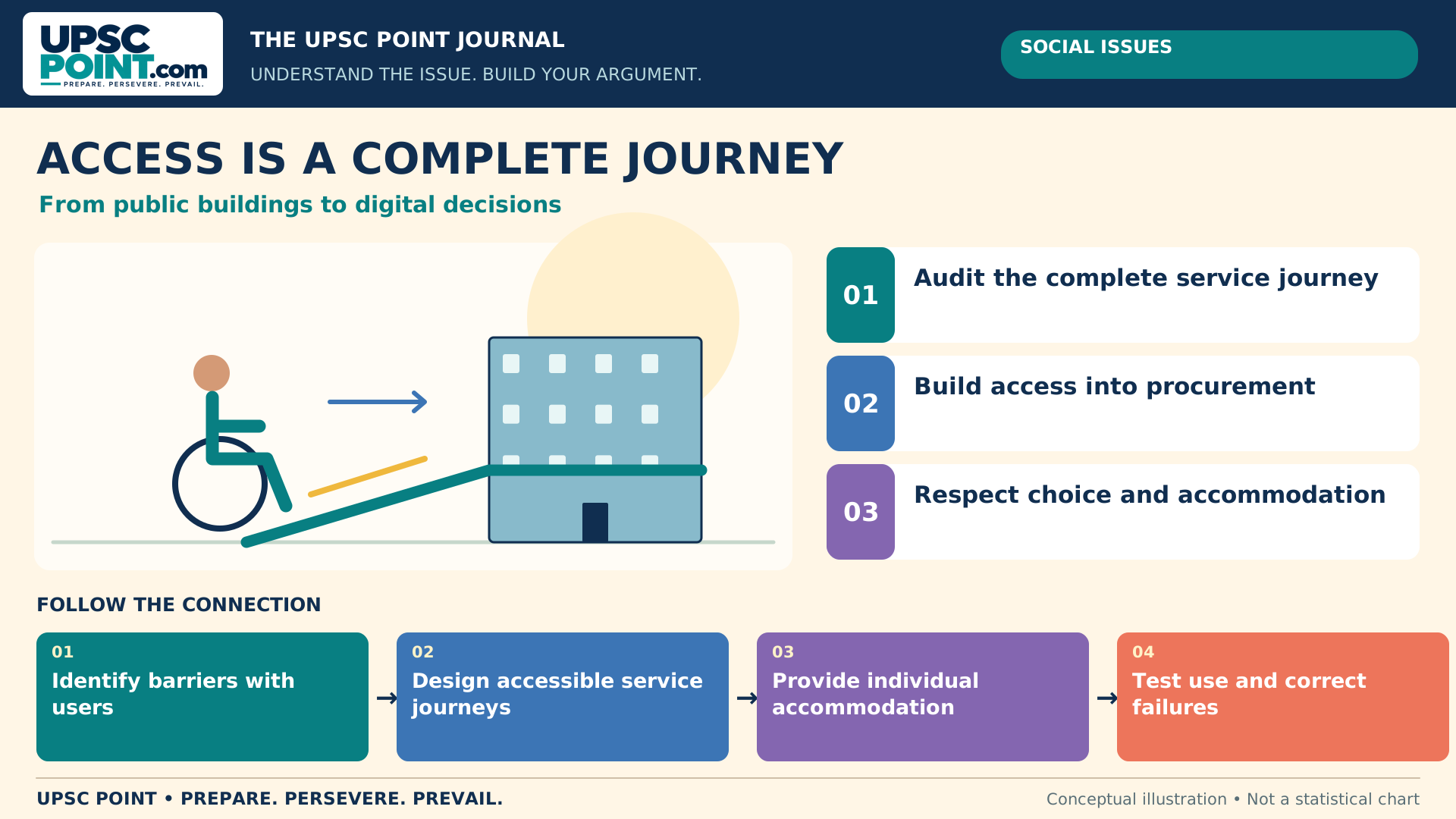
Disability inclusion is sometimes reduced to a ramp or a separate benefit. Physical access matters, but classroom participation also depends on usable materials, communication, teacher support and assessment arrangements. UNICEF’s work on disability-inclusive education examines barriers at both school and system levels. The point is to organise the system around participation rather than ask every learner to adapt unaided. [2]
A material that can be read at a larger size, a clear explanation delivered in more than one way, or an assessment that distinguishes knowledge from an inaccessible format can help. Such adjustments need judgement. The aim is not to lower expectations without thought; it is to remove an irrelevant obstacle to demonstrating learning.
Teachers need time as well as instructions
It is easy to make every reform a new task for the teacher. Diagnose each learner, record every outcome, use new technology, communicate with families and complete administrative reports. A policy may look comprehensive because the list is long. In a working classroom, the competing demands may leave less time to teach.
Support should therefore include realistic schedules, suitable material and help with decisions. Training is more useful when it addresses a classroom problem and permits follow-up than when it is judged solely by attendance. Teachers also need a way to report that a prescribed approach is not working without being treated as resistant to reform.
Technology can widen access or widen the gap
A digital resource may make a good explanation available beyond one classroom. But possession of a device is only one part of access. Shared use, connectivity, language, accessibility and a quiet place to work also shape the experience. A portal with many uploads can still be difficult for the learner who needs a clear next step.
The useful question is what the technology allows the learner or teacher to do better. Does it provide feedback that can be acted on? Does it work with a weak connection? Is a comparable non-digital route available? Technology should be evaluated as an arrangement for learning, not as a substitute for explaining the learning problem.
Measure progress without teaching to the measurement
Assessment can reveal a gap before it becomes entrenched. It can also encourage narrow preparation if a single score becomes the only sign of success. A balanced approach uses evidence to guide teaching while recognising that not every worthwhile outcome fits one test.
Consider the distinction between recognising a rehearsed question and applying the idea in a different situation. Both may produce a correct answer, but they do not reveal the same understanding. Schools need a manageable combination of observation, discussion and assessment. Excessive data collection can be as unhelpful as having no evidence.
A more demanding idea of equal opportunity
Equal treatment is not always equal support. Giving identical material to learners facing different barriers may reproduce the gap. The policy challenge is to direct additional help where it is needed without turning that help into stigma or lowering the learner’s future possibilities.
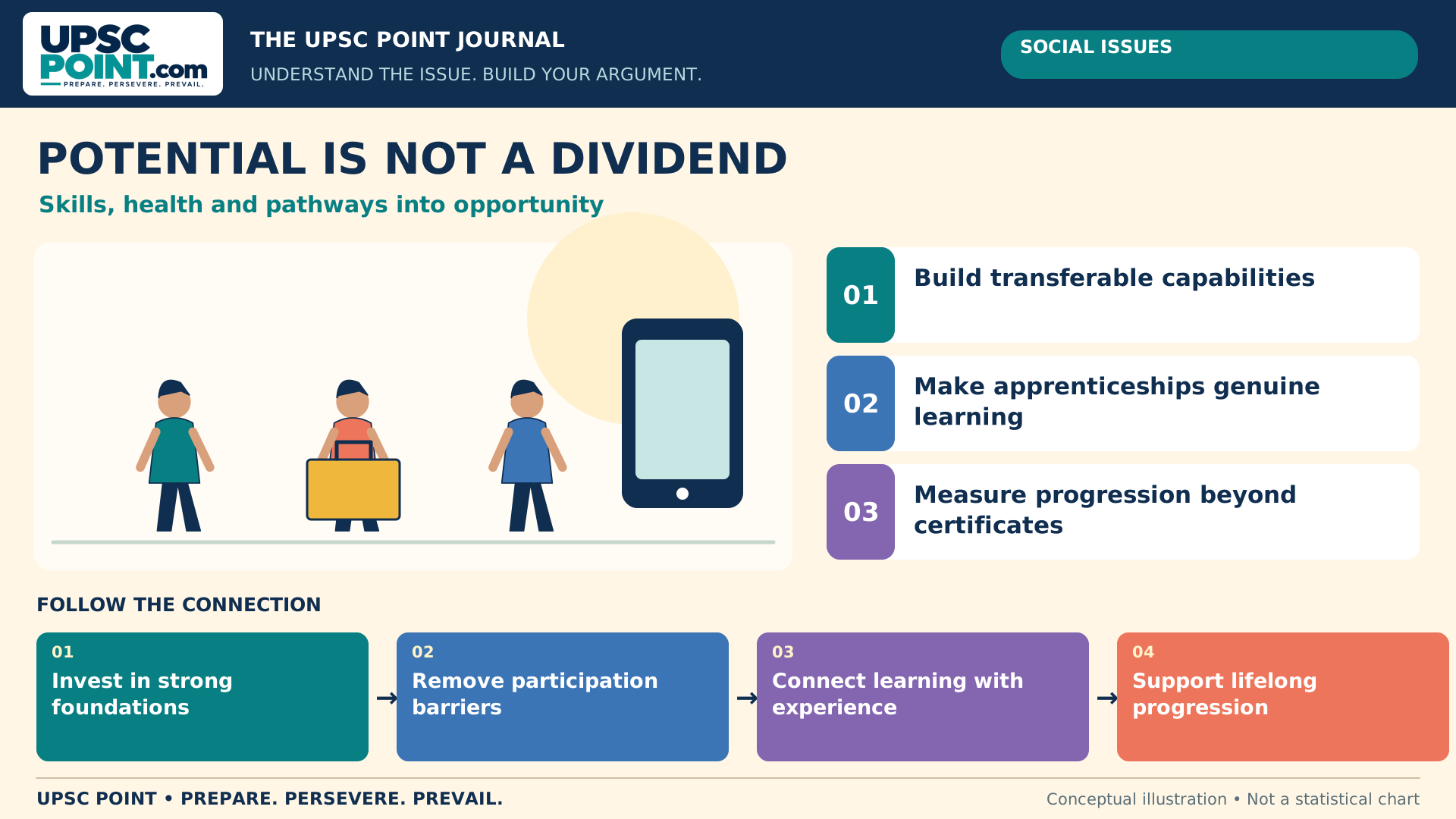
For an aspirant, the strongest education answer follows the child through entry, attendance, participation, learning and progression. It asks where the chain breaks and who can repair it. The ambition should be greater than keeping a name on a register: the child should be able to make sense of the world, use what has been learned and continue learning with confidence.
A framework to revise this issue
- 01Entry and attendance
- 02Participation and support
- 03Understanding and feedback
- 04Progression and opportunity
| Concept or claim | What to examine |
|---|---|
| Enrolment | Is the child on the register? |
| Participation | Can the child use the classroom and materials? |
| Learning | Can the child explain and apply an idea? |
A question to think through
Explain why equitable access to schooling must be linked to classroom participation and meaningful learning. (250 words)
Build a position, explain its mechanism, consider a counterargument and propose a workable response.
Sources & further reading
Sources provide the factual anchors. The arguments and proposed evaluation frameworks are editorial analysis; illustrative scenarios are hypothetical.
Found an error or a source that needs updating? Send the article title and the passage to our support team.