
July – September 2026
UPSC Current Affairs Magazine
Connect parliamentary work, examination integrity, social security, economic activity, international cooperation and scientific milestones. Each chapter is a starting point for revision and answer-writing practice.
News cutoff: 2026-09-30 · Original edition published 12 November 2026. This is a retrospective quarterly selection.
Inside this edition
22 analytical chapters, visual explanations, 50 Prelims questions with explanations and Mains practice. The page numbers below refer to the PDF.
- 1. Parliament: what a session’s numbers tell usp. 8 ↗
- 2. Examination integrity: rebuilding public trustp. 11 ↗
- 3. Judicial capacity: posts, benches and timely justicep. 14 ↗
- 4. EPFO coverage: widening the social-security netp. 17 ↗
- 5. Adult literacy: learning that changes everyday choicesp. 20 ↗
- 6. Khelo India: participation before the podiump. 23 ↗
- 7. RBI’s August decision: balancing growth and pricesp. 26 ↗
- 8. Cooperative banks: reopening entry with safeguardsp. 29 ↗
- 9. GDP in August: match the number to its periodp. 32 ↗
- 10. Mobile manufacturing: from assembly to domestic valuep. 35 ↗
- 11. Semicon 2.0: building the complete chip ecosystemp. 38 ↗
- 12. GOBARdhan: make the waste-to-gas chain workp. 41 ↗
- 13. Offshore exploration: security with geological uncertaintyp. 44 ↗
- 14. Rail capacity: removing bottlenecks in a networkp. 47 ↗
- 15. BRICS in New Delhi: representation and practical cooperationp. 50 ↗
- 16. SCO at twenty-five: security, connectivity and opportunityp. 53 ↗
- 17. Sarnath: heritage, history and living responsibilityp. 56 ↗
- 18. Glaw Lake: protect the catchment, sustain the wetlandp. 59 ↗
- 19. El Niño preparedness: turn forecasts into local decisionsp. 62 ↗
- 20. Gaganyaan: why human-rating takes repeated testsp. 65 ↗
- 21. EOS-05: observing Earth from a different orbitp. 68 ↗
- 22. Mpox vaccines: preparedness through equitable accessp. 71 ↗
Preview before you download
Parliament: evaluate work beyond the number of sittings
An additional reading guide for this webpage, not a quotation from the PDF. Published 13 November 2026.
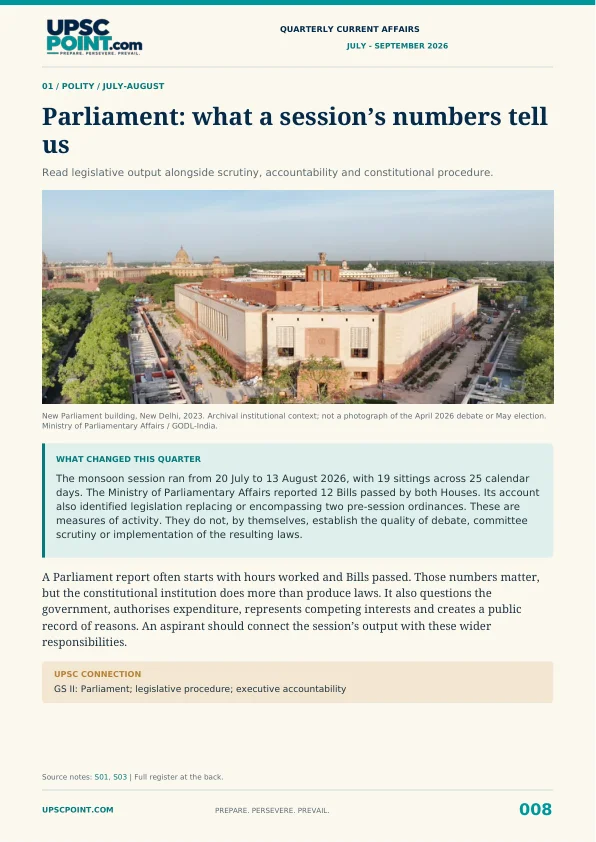
A session’s sitting time is a useful starting measure, but it does not describe the quality of scrutiny by itself. Read it alongside the opportunity to question the executive, examine legislation and discuss public spending. Identify what each measure can establish and what it leaves unanswered.
For an analytical answer, distinguish the volume of parliamentary business from the process used to examine it. Committee consideration, access to information and reasoned debate can help explain how scrutiny works. Use the chapter’s dated evidence for the particular session and avoid turning one figure into a complete assessment of institutional performance.
Prelims check
Distinguish a Bill’s introduction, passage in the relevant Houses, assent and commencement. These are separate stages.
Mains practice
Which indicators would you use to assess the effectiveness of parliamentary scrutiny, and why?
Build your response around the issue, the mechanism, the trade-offs and the evidence needed for a conclusion. Use the sources in the magazine for event-specific facts.
From reading to recall
Read one chapter
Write its central idea in two sentences, then identify its syllabus connection.
Test your understanding
Attempt the magazine’s questions before opening their explanations. Keep an error log.