
January – March 2026
UPSC Current Affairs Magazine
Read the first quarter through public spending, social protection, trade partnerships, technology and environmental governance. The chapter list below takes you directly to the corresponding pages in the original edition.
News cutoff: 2026-03-31 · Original edition published 12 November 2026. This is a retrospective quarterly selection.
Inside this edition
22 analytical chapters, visual explanations, 50 Prelims questions with explanations and Mains practice. The page numbers below refer to the PDF.
- 1. Budget 2026-27: the quality of public spendingp. 7 ↗
- 2. Growth numbers: what changed with the GDP series?p. 10 ↗
- 3. Financing enterprise: SIDBI and Startup Fund of Fundsp. 13 ↗
- 4. Atal Pension Yojana: the challenge of income in old agep. 16 ↗
- 5. Urban Challenge Fund: making city finance workp. 19 ↗
- 6. BHAVYA: industrial parks and the missing connectionsp. 22 ↗
- 7. Census 2027: preparing to count a changing Indiap. 25 ↗
- 8. Menstrual health: making the right to education usablep. 28 ↗
- 9. HPV vaccination: prevention as public policyp. 31 ↗
- 10. India-EU: trade access and strategic partnershipp. 34 ↗
- 11. India-US trade: read the sequence, not one headlinep. 37 ↗
- 12. India-France: partnership with room for independent choicesp. 40 ↗
- 13. AI Impact Summit: access, trust and public valuep. 43 ↗
- 14. PSLV-C62: reliability, failure analysis and the space economyp. 46 ↗
- 15. India’s 2031-35 NDC: three targets, three different meaningsp. 49 ↗
- 16. Ramsar wetlands: recognition is the beginningp. 52 ↗
- 17. The high seas treaty enters into forcep. 55 ↗
- 18. Bharat-VISTAAR: useful agricultural advice needs local knowledgep. 58 ↗
- 19. Modified UDAN: connectivity that lastsp. 61 ↗
- 20. Bharat Tribes Fest: culture, markets and control over valuep. 64 ↗
- 21. West Asia: India’s exposure to a regional conflictp. 67 ↗
- 22. Small hydropower: renewable does not mean impact-freep. 70 ↗
Preview before you download
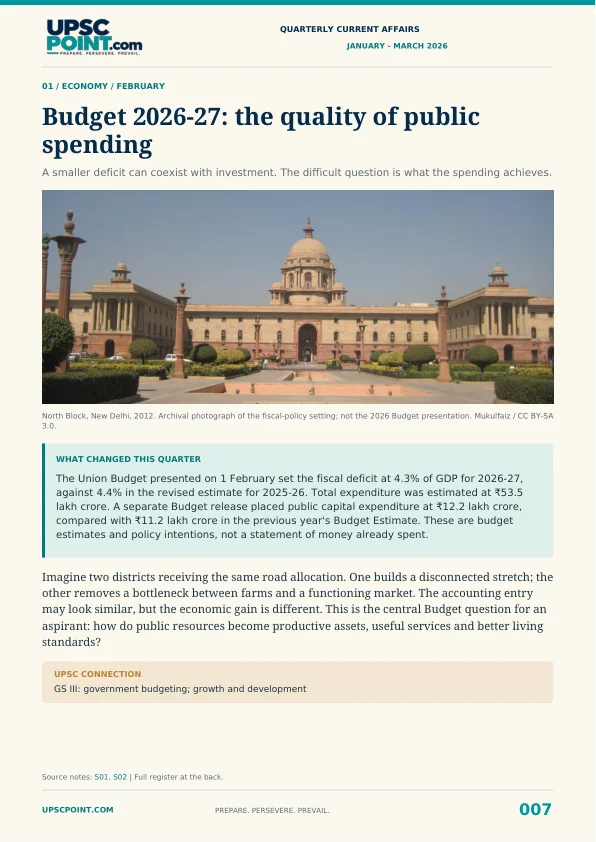
Budget 2026–27: ask what spending achieves
An additional reading guide for this webpage, not a quotation from the PDF. Published 13 November 2026.
Begin with the distinction between allocating money and delivering a service. A budget provision is an input; a completed facility or trained staff member is an output. The change in people’s access or well-being is an outcome. Keeping these stages separate helps you avoid treating a larger allocation as automatic evidence of success.
For a Mains answer, choose a public service and trace how funding reaches the implementing institution. Ask whether staffing, maintenance, procurement and local capacity support the intended result. A balanced answer can recognise the purpose of an allocation while examining the evidence needed to evaluate delivery.
Prelims check
Keep financial-year labels, revised estimates, budget estimates and actual expenditure separate. Read the original document before quoting a figure.
Mains practice
Why should the quality of public expenditure be assessed alongside its size? Outline an answer using inputs, outputs and outcomes.
Build your response around the issue, the mechanism, the trade-offs and the evidence needed for a conclusion. Use the sources in the magazine for event-specific facts.
From reading to recall
Read one chapter
Write its central idea in two sentences, then identify its syllabus connection.
Test your understanding
Attempt the magazine’s questions before opening their explanations. Keep an error log.