Farm Incomes and MSP: Why Prices, Procurement and Markets Must Work Together
Understand how MSP, procurement, storage and market access affect farm incomes, and why a higher announced price alone cannot resolve agricultural distress.
GS III · agricultural marketing, MSP and food security

A crop can sell at a respectable price and still leave its grower with little income. Costs may have risen, part of the harvest may have spoiled, or repayment obligations may have forced an early sale. Farm incomes emerge from an entire production and marketing process. Minimum Support Price is an important part of that discussion, but treating it as the whole discussion leaves several practical problems untouched.
Explore this article Sections & revision ↓
Begin with net income rather than the price headline
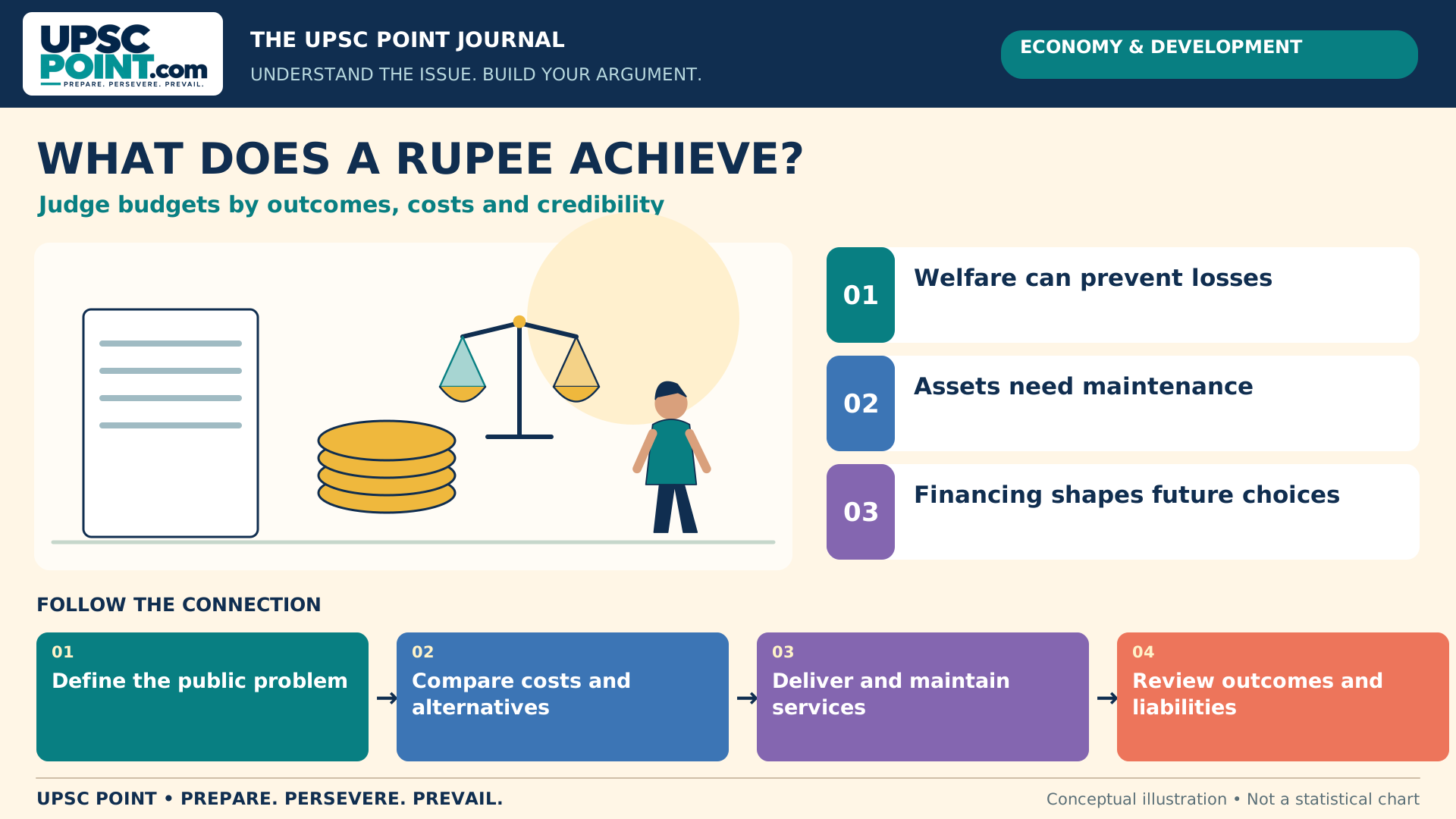
Farm revenue depends on both the quantity sold and the price received. Net income requires subtracting production, transport, storage and finance costs. Family labour also has an economic value even when no wage payment changes hands. A price increase can therefore coexist with weak profitability if input expenses rise faster or crop damage reduces the marketable harvest.
This accounting distinction is essential when comparing policies. An irrigation improvement may raise dependable output, an organised sale may improve the realised price, and lower transport losses may preserve more produce. Each can improve income through a different channel. None should be evaluated solely by whether the announced market price changes. The household's income from livestock or non-farm work also matters, though this article concentrates on crop marketing.
What an announced MSP does and does not establish
MSP is a policy price, whereas procurement is an actual purchase operation. They are related but not interchangeable. An announced price does not establish that a purchasing centre is conveniently located, that the crop meets quality requirements or that payment arrives when the farmer needs it. Access to the mechanism is as important as the level of the price.
A 2020 government explanation of MSP calculations states that CACP considers production costs and other price-policy factors, distinguishes A2+FL from the broader C2 cost concept, and describes C2 as a benchmark reference in its recommendations. [1] This historical explanation should not be confused with a current seasonal price list. It helps clarify why arguments about a margin over cost can conceal disagreement about which cost measure is being used.
Procurement is also a logistical institution
Buying agricultural output involves more than announcing willingness to purchase. Agencies need accessible centres, weighing arrangements, quality assessment, storage, movement and reliable accounts. Farmers need understandable procedures and information about timing. When these systems work poorly, the effective benefit of a support price can shrink through travel costs, waiting, rejected produce or delayed payments.
Imagine a hypothetical farmer who must hire a vehicle and lose a working day to reach a distant centre. A nearby trader offering a lower price but immediate payment may still be the more feasible option. Describing that sale as an entirely free choice overlooks liquidity and transaction costs. Improving procurement access therefore requires examining what happens between the farm gate and the final payment, not only the quantity ultimately purchased.
Price protection and food security can intersect
Public purchasing may support producer prices while supplying grain for food-security programmes. This creates a useful connection between agricultural policy and household consumption. It also creates difficult management questions. The crops procured, storage losses, distribution requirements and fiscal costs must be considered together. Purchasing without a credible plan for use can generate expensive inventories rather than durable welfare.
Consumers and producers are not always separate groups. A small farmer may sell one crop and purchase other food throughout the year. Higher food prices can improve one source of revenue while increasing household expenses. Public debate becomes clearer when it avoids imagining that every farmer gains from every price increase. Policy design must consider the net position of different households and the broader food basket.
Storage changes when a farmer must sell
Perishable produce leaves little room to wait for a better offer. Even storable crops require facilities, finance and confidence that quality will be maintained. A farmer who needs immediate cash cannot benefit from potential future prices without some way to cover current obligations. Storage and working capital are therefore connected instruments, not separate infrastructure and banking issues.
Collective facilities may reduce individual costs, but they still require professional operation. A warehouse without dependable grading, records and market links may merely postpone the problem. Public support should examine utilisation, maintenance and the distribution of benefits. It is also necessary to distinguish a commercially viable storage need from speculative expectations that every future price will be higher than the present one.
Better information needs a usable market behind it
Knowing prices elsewhere does not automatically allow a farmer to sell there. Buyers must trust quality, contracts must be enforceable and transport must be affordable. The Agriculture Ministry's AgriFarmap description identifies cost-of-cultivation information as an input into agricultural price policy. [2] That reminds us that dependable evidence is needed on both sides of the transaction: what production costs and what buyers actually offer.
Digital platforms can make offers and records more visible, but they cannot physically grade produce or resolve every dispute by themselves. Their usefulness depends on the surrounding institutions. A small grower may need assistance aggregating a marketable lot and understanding payment terms. Digital access should therefore be assessed by completed, satisfactory transactions rather than the number of accounts created or prices displayed on a screen.
The competing arguments deserve careful treatment
Supporters of stronger price guarantees emphasise farmers' exposure to weather, volatile markets and unequal bargaining power. These are serious concerns, particularly when investments are made months before output can be sold. Critics worry about fiscal burdens, implementation difficulties and incentives to continue cultivating crops that strain local resources. These concerns are also real and cannot be settled by declaring either markets or government inherently reliable.
The relevant comparison is between feasible policy packages. Price support might be combined with risk management, diversified procurement where appropriate, extension services and stronger producer organisations. Any proposal must explain how quality, coverage, finance and market response would be handled. It must also recognise that measures suitable for a widely stored grain may not transfer easily to vegetables, fruit or other rapidly perishable produce.
Make diversification financially credible
Advising farmers to diversify is easy; making the transition dependable is harder. A new crop may require unfamiliar techniques, different equipment and a buyer who appears only after quality has been established. Farmers reasonably hesitate when one crop has an established marketing channel and another offers only a promise. Environmental objectives will be more persuasive when accompanied by a credible commercial pathway.
A practical income strategy would therefore coordinate local agronomy, buyer access, storage, timely payment and risk protection. It would publish clear procurement information and evaluate who can actually use it. It would also examine income stability over several seasons rather than celebrating one favourable harvest. MSP remains important, but resilient agriculture requires the institutions that allow farmers to produce efficiently, negotiate fairly and sell without being forced into avoidable distress.
A framework to revise this issue
- 01Production costs and risks
- 02Marketable harvest
- 03Price and payment access
- 04Net farm income
| Concept or claim | What to examine |
|---|---|
| MSP | An announced policy support price |
| Procurement | Actual purchasing under an arrangement |
| Net income | Revenue after relevant costs |
A question to think through
Explain why agricultural price support must be complemented by effective marketing institutions to improve farm incomes. Discuss implementation and environmental trade-offs. (250 words)
Build a position, explain its mechanism, consider a counterargument and propose a workable response.
Sources & further reading
Sources provide the factual anchors. The arguments and proposed evaluation frameworks are editorial analysis; illustrative scenarios are hypothetical.
Found an error or a source that needs updating? Send the article title and the passage to our support team.