Informal Employment and Social Security: Protection That Follows the Worker
Explore why informal workers need portable, affordable social protection and why registration must lead to usable benefits rather than another database.
GS II · welfare; GS III · employment and inclusive growth

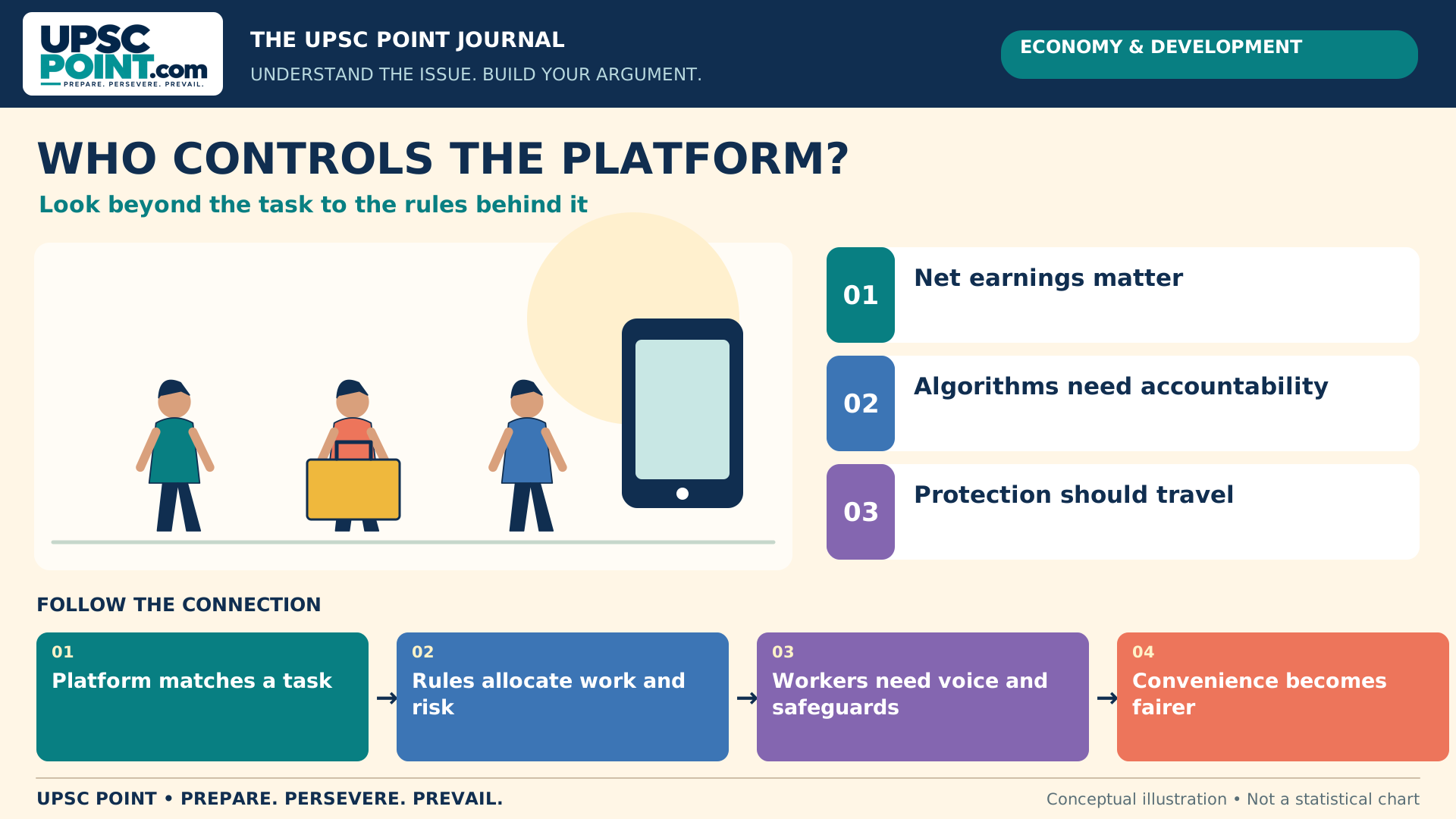
A worker changes employers, moves to another district and switches between daily wages and small self-employment. The risks of illness, injury and old age do not disappear during these transitions. Yet protection built around one stable employer can leave precisely such a worker outside its reach. The challenge is to design social security around real working lives rather than an ideal employment history that many people do not have.
Explore this article Sections & revision ↓
Informality is broader than an unregistered shop
It is tempting to identify informal work by looking at the size or appearance of a workplace. That approach misses employees working informally inside formal supply chains, home-based producers and people with unclear employment relationships. The ILO's Recommendation No. 204 expressly recognises that insufficient formal coverage can affect different kinds of workers and economic units. [1] Informality is therefore a relationship to institutions, not merely a type of building.
This distinction changes the policy response. Registering an enterprise may improve visibility without changing the conditions of everyone who works for it. Conversely, protecting a worker need not wait until every aspect of the enterprise has been formalised. The questions are practical: which risks are covered, who finances the protection, how a claim is made and whether the worker can obtain a remedy when something goes wrong.
A database is not the same as a safety net
Registration can help identify workers and connect fragmented administrative systems. It can reduce repeated documentation and make outreach easier. But an entry in a database is an administrative achievement, not proof of income security. A person may be registered and still lack a relevant entitlement, know little about it or face an application process that is impossible to complete during a working day.
A meaningful evaluation follows the whole journey from enrolment to benefit. It asks whether records remain accurate after migration, whether assistance is available offline and whether rejected claims can be challenged. Coverage statistics should distinguish eligibility, registration, active contribution and actual benefit receipt. Combining these stages into one large number can make a programme appear more effective than workers experience it to be.
Different risks require different instruments
An accident creates an immediate expense; old age requires support over many years. Short interruptions in earnings differ from permanent disability. Social assistance, insurance and savings can each address part of this landscape, but they are not interchangeable. A savings account offers limited protection to somebody whose accumulated balance is exhausted by one major shock.
Insurance pools risk, while publicly financed assistance can protect people unable to contribute sufficiently. Choosing the mix requires explicit decisions about eligibility, benefits and funding. A programme should not promise comprehensive security while financing only a narrow event. Clear communication about exclusions is part of good design because workers make consequential decisions based on what they believe a policy will cover.
Contributions must fit irregular earnings
Monthly payroll deductions are easier to administer when wages arrive on a predictable schedule. Informal earnings may fluctuate by season, weather and available work. A rigid contribution requirement can cause protection to lapse during the very period in which a worker becomes more vulnerable. Designing around contributory capacity means acknowledging these fluctuations rather than treating every missed payment as unwillingness to participate.
Consider a hypothetical street vendor whose business slows during prolonged road repairs. Flexible payment intervals, a reasonable grace period or subsidised contributions might preserve protection. Each option has a financing cost and must be designed transparently. The choice is not between perfect individual payment and unlimited subsidy. It is between different ways of sharing risks while keeping the scheme financially credible and administratively manageable.
Portability must work beyond the identification number
A portable identity can help establish who a worker is. Portability of protection also requires the receiving institution to recognise eligibility, provide the service and settle financial responsibility. Without these arrangements, a worker may carry a valid number but still be told to return to the original place of registration. Technology cannot resolve an unresolved division of responsibility on its own.
Imagine a hypothetical construction worker injured after moving for a project. A usable system would explain where treatment and claims can be accessed, how employment information is established and which authority handles disputes. It would not require the worker to negotiate independently between distant offices. Portability should be tested through real service journeys across locations, including situations where documents are incomplete or an employer is uncooperative.
Protection can support productive transitions
Social security is sometimes described as a cost that competes with economic activity. It can also make activity less fragile. A worker with basic protection may be less likely to sell productive equipment during a health emergency or accept an unsafe offer simply to secure immediate cash. Security can expand the ability to search for a better opportunity rather than remain trapped in the first available one.
The India Employment Report 2024 highlights persistent weaknesses in employment quality and widespread informality. [2] This does not mean every informal enterprise should be treated as identical. Some need productivity support, others need clearer employment relationships, and many need both. Protection should accompany viable enterprise development, not become an excuse to ignore low earnings, delayed payment or hazardous work.
Who should pay, and who should answer?
Employers, workers and public budgets may each have a role, but responsibilities must be explicit. Where a commercial actor benefits from labour while avoiding a recognised employment relationship, shifting every obligation to the taxpayer can reward avoidance. On the other hand, demanding substantial contributions from very low-income workers can make nominally inclusive schemes inaccessible. Classification and financing must be considered together.
Administration also needs accountability. Workers should receive understandable statements, claim timelines and reasons for rejection. Intermediaries should not be able to charge unofficial fees for basic access. Independent grievance channels and worker participation can reveal failures that aggregate dashboards miss. The purpose of these safeguards is not procedural decoration; it is to make a promise of protection credible to people with limited time and bargaining power.
Judge success when an ordinary working life changes
A practical strategy would start with a clearly financed minimum package, simplify access and gradually deepen coverage. It would preserve assisted and offline channels alongside digital services. It would also monitor exclusion errors, interrupted coverage and claim outcomes, rather than only celebrating enrolment campaigns. Expansion should follow evidence about which risks remain uncovered and which procedures workers find hardest to navigate.
For UPSC analysis, the central principle is continuity. A person should not lose all meaningful protection whenever the identity of an employer, location of work or form of earning changes. This is a design objective rather than a claim that such continuity already exists. Formalisation becomes socially valuable when institutions make work more secure, productive and fair. Its success is ultimately visible in a worker's ability to withstand a difficult month without losing the foundations of a livelihood.
A framework to revise this issue
- 01Recognise changing work
- 02Finance relevant protection
- 03Make benefits portable
- 04Verify access and remedies
| Concept or claim | What to examine |
|---|---|
| Registration | Administrative identification |
| Coverage | A defined protection applies |
| Effective access | The worker can actually use it |
A question to think through
How can India extend effective social security to informal workers without confusing registration with protection? Discuss portability, financing and accountability. (250 words)
Build a position, explain its mechanism, consider a counterargument and propose a workable response.
Sources & further reading
Sources provide the factual anchors. The arguments and proposed evaluation frameworks are editorial analysis; illustrative scenarios are hypothetical.
Found an error or a source that needs updating? Send the article title and the passage to our support team.