Delimitation Bill 2026 explained: seat shares, boundaries and women’s reservation
What would a 50% seat increase mean for a state’s share? Work through a two-state example and read the November delimitation proposal alongside Article 368.
GS II · Representation of states, electoral systems and constitutional amendment
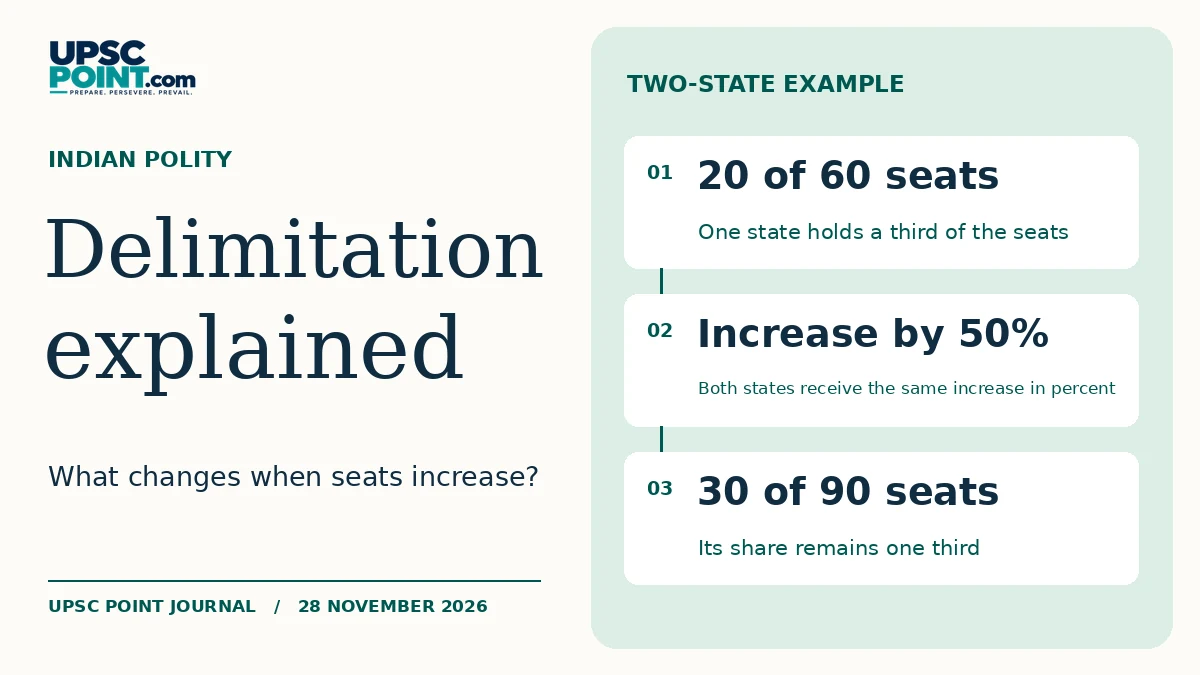
Suppose two states send 20 and 40 representatives to a House. If both delegations grow by half, does the larger state gain a bigger share? The answer explains why the November debate involves three questions: how many seats each state receives, where the boundaries run and which seats are reserved.
Explore this article Sections & revision ↓
First read the status line
Parliament’s circulated text of the Constitution (132nd Amendment) Bill is marked for introduction. Its clauses propose higher ceilings for representation and a 50% seat increase through a future delimitation exercise. A separate statement explains why the government proposed withdrawing the earlier Delimitation Bill. These November documents describe different legislative steps. Neither document gives a voter a new constituency. [1][2]
A two-state calculation you can repeat
In our simplified House, the smaller state holds 20 of 60 seats, or one-third. A uniform 50% increase gives the two states 30 and 60 seats. The smaller state now holds 30 of 90, still one-third. Both groups gained representatives. Their relative shares in this example stayed the same.
Now keep the original 20 seats in one state and imagine its capital has grown faster than its rural districts. A commission could adjust boundaries inside the state without changing its seat total. That changes which voters elect each representative. The example uses round numbers for teaching. It is not a forecast of any state’s final allocation.
Where does women’s reservation enter?
The draft’s proposed Article 334A connects implementation of women’s reservation with the first delimitation exercise after the proposed amendment commences. Reservation determines which seats are reserved for women. It is distinct from allocating seats among states and from drawing a constituency boundary. For a Mains answer, use a different question for each: how many seats, which voters and what reservation rule? [1]
What does a special majority require?
Article 368 requires a majority of the total membership of each House and at least two-thirds of its members present and voting. Both tests apply in each House. For changes specified in the article’s proviso, ratification by at least half of the state legislatures is also required before presentation for assent. [3]
Practice question: In a hypothetical House with a total membership of 120, 72 members are present and voting. If 55 vote in favour, has the bill met both parliamentary thresholds in that House?
A. Yes, because 55 exceeds 48. · B. No, because at least 61 affirmative votes are needed for the total-membership test. · C. Yes, because only members voting count. · D. No, because all 120 must vote.
Answer B. Two-thirds of 72 is 48. Fifty-five clears that test but falls below a majority of 120. In this example 61 affirmative votes would satisfy both tests. [3]
A framework to revise this issue
- 01Count seats per state
- 02Calculate each share
- 03Map constituencies
- 04Apply reservation rules
| Concept or claim | What to examine |
|---|---|
| Allocation | How many seats does the state receive? |
| Delimitation within a state | Which voters form each territorial constituency? |
| Reservation | Which seats are set aside under the applicable law? |
A question to think through
Can a uniform increase in seats settle every concern about political representation? Examine parliamentary seat shares and constituency boundaries separately. (150 words)
Build a position, explain its mechanism, consider a counterargument and propose a workable response.
Sources & further reading
Sources provide the factual anchors. The arguments and proposed evaluation frameworks are editorial analysis; illustrative scenarios are hypothetical.
- Parliament of India · Constitution (132nd Amendment) Bill as circulated ↗
- Lok Sabha · Statement of reasons for withdrawing the earlier Delimitation Bill ↗
- Legislative Department · Constitution of India, Article 368 ↗
Found an error or a source that needs updating? Send the article title and the passage to our support team.