Adjournment, Prorogation and Dissolution of Parliament Explained
Who can end a sitting, a session or the life of the Lok Sabha? Learn what happens to pending bills under Articles 85 and 107, with a UPSC practice question.
GS II · Parliament, legislative procedure and executive accountability
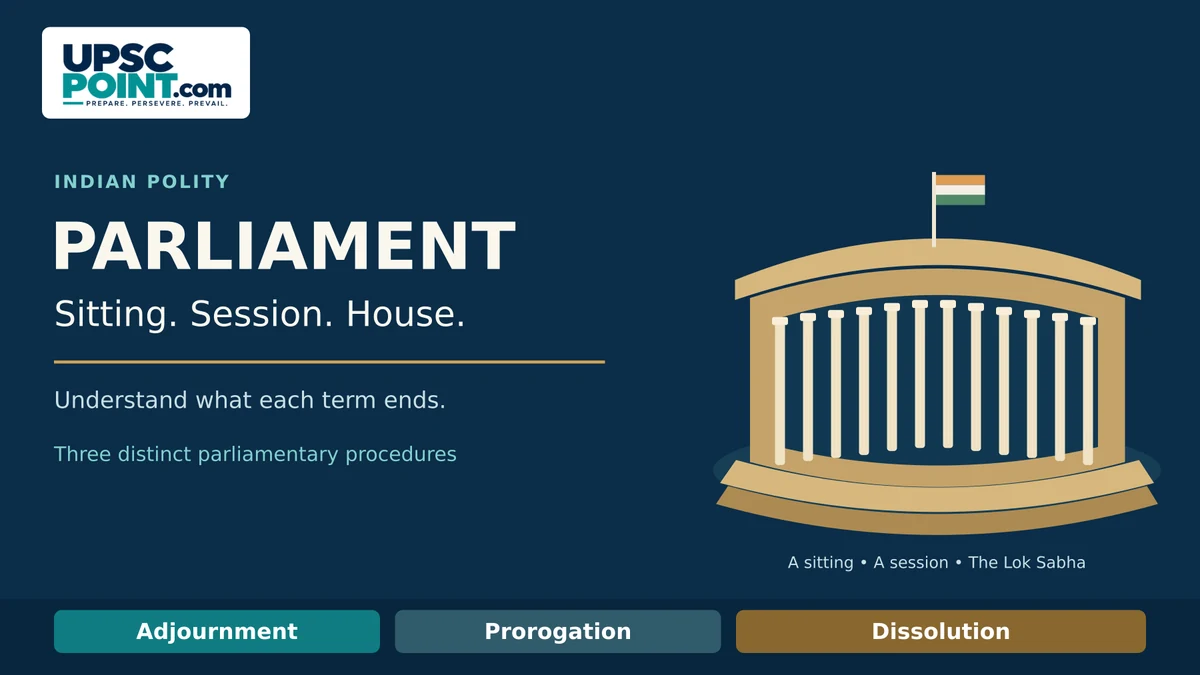
A House can stop meeting while its session remains open. Reporting on 22 November put the gap since the Monsoon Session’s adjournment at more than 100 days, with no prorogation. To understand how that is possible, ask what has ended: today’s sitting, this session or the elected House itself? [1][2]
Explore this article Sections & revision ↓
Adjournment ends or pauses a sitting
A sitting is a meeting of a House. In the Lok Sabha the Speaker can adjourn it to a specified time, including later the same day. An adjournment sine die leaves the next sitting’s date open. Rule 15 allows the Speaker to call the Lok Sabha back after an adjournment sine die while the session continues. [3]
Imagine the House adjourns on Friday without naming a return date. A promise to debate a bill can still have political importance, but the adjournment has not erased the bill or dissolved the House. Look for a separate presidential order if the question asks whether the session formally ended. [2][3]
Prorogation closes a session
Under Article 85, the President can prorogue either House or both. A new session requires a summons. The six-month limit is measured between the last sitting of one session and the date appointed for the first sitting of the next. It does not fix a minimum number of days on which Parliament must meet each year. [2]
Article 107(3) protects pending bills when a session ends. If a transport bill has been introduced and a session is prorogued before the vote, that event alone leaves the bill available for further consideration. [2]
Dissolution and the fate of pending bills
Dissolution ends the life of the Lok Sabha. Rajya Sabha continues under Article 83. For an ordinary bill, ask where the bill is pending and whether Lok Sabha has already passed it. A bill pending in Lok Sabha lapses on dissolution. So does a bill already passed there and pending in Rajya Sabha, subject to Article 108. [2]
A bill introduced in Rajya Sabha and still pending there survives if Lok Sabha has never passed it. Another qualification concerns a joint sitting: if the President has already notified the intention to summon one under Article 108, a subsequent dissolution need not prevent the joint sitting. In an exam, the sequence of events can change the answer. [2]
Prelims practice on a pending bill
Practice question: An ordinary bill is introduced in Rajya Sabha. It is still pending there and has never been passed by Lok Sabha. What happens when Lok Sabha is dissolved?
A. It lapses immediately. · B. It remains pending in Rajya Sabha. · C. It automatically goes to a joint sitting. · D. It goes directly to the President for assent.
Answer B. Article 107(4) preserves a bill at this stage. There has been no passage by both Houses for assent and the facts establish no joint-sitting trigger. [2]
A framework to revise this issue
- 01Identify the sitting
- 02Check if the session ended
- 03Check if Lok Sabha dissolved
- 04Trace the bill’s last stage
| Concept or claim | What to examine |
|---|---|
| Adjournment sine die | The next sitting has no fixed date. The session can remain open. |
| Prorogation | The President ends the session of a House. Pending bills survive this event. |
| Dissolution | The elected Lok Sabha ends. A pending bill’s legislative history determines its fate. |
A question to think through
How does the distinction between a sitting and a session affect Parliament’s capacity to hold the executive to account? Use one example. (150 words)
Build a position, explain its mechanism, consider a counterargument and propose a workable response.
Sources & further reading
Sources provide the factual anchors. The arguments and proposed evaluation frameworks are editorial analysis; illustrative scenarios are hypothetical.
- The Indian Express, 22 November 2026 · Why the interval after adjournment matters ↗
- Legislative Department · Constitution of India, Articles 83, 85, 107 and 108 ↗
- Lok Sabha Secretariat · Rules of Procedure and Conduct of Business, Rule 15 ↗
Found an error or a source that needs updating? Send the article title and the passage to our support team.