Undertrial Detention and Prison Reform: Making Legal Rights Effective
Examine why undertrial detention requires timely legal assistance, accurate case records and humane prison conditions, with safeguards for justice and public safety.
GS II · judiciary, vulnerable groups and access to justice; GS IV · human dignity

A person can remain inside a prison while the question of guilt is still unresolved. That distinction is the starting point of any serious discussion of undertrial detention. A prison population is not a single legal category, and prison reform is not simply a debate about treating convicted offenders more leniently. It concerns the use of state custody, the progress of legal proceedings and the dignity of every person held by public authority.
Explore this article Sections & revision ↓
Separate legal status from public assumptions
An undertrial is awaiting the completion of relevant proceedings rather than serving a sentence following conviction in that case. Detention can be authorised for legally recognised reasons, but it should not be casually described as punishment already deserved. Public discussion often erases this distinction, especially when an allegation is serious or emotionally charged. That erasure weakens attention to procedural safeguards.
Recognising the distinction does not minimise harm suffered by victims or deny legitimate concerns about intimidation, evidence or flight. It requires a reasoned assessment rather than automatic conclusions. The justice system must protect the integrity of proceedings while ensuring that unresolved allegations do not become a substitute for a judicial determination reached through a fair process.
The route out of custody can fail at several points
A person may need legal advice, an application, a hearing, compliance with an order and correct communication between institutions. A failure at any stage can prolong custody. Documents may be incomplete, the person may not understand an order, or a release direction may not be promptly reflected in the relevant records. These are administrative issues with direct consequences for liberty.
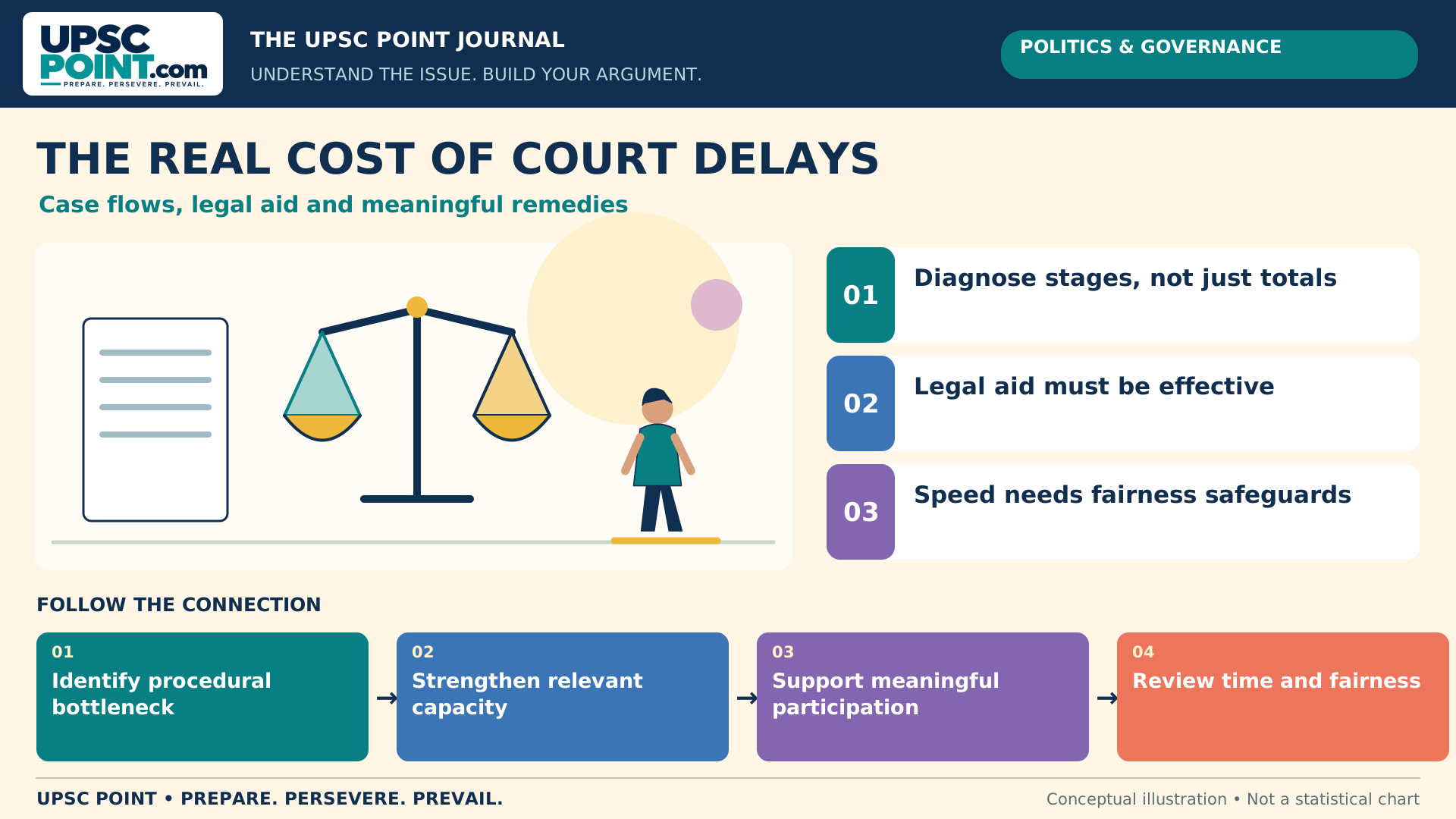
Reform should therefore map the whole journey rather than count only applications filed. A favourable legal decision is important, but the person’s actual position depends on implementation. Institutions need clear responsibility for checking outstanding requirements and resolving discrepancies. A process that assumes the prisoner can independently coordinate lawyers, courts, family members and prison officials overlooks the restrictions custody itself imposes.
Legal aid must reach people before problems accumulate
NALSA’s public guidance identifies persons in custody among categories eligible for legal services under the statutory framework. It explains that legal assistance can include representation and advice. This matters because lack of personal income is not the only reason a detained person may struggle to secure meaningful assistance or understand the next procedural step. [1]
Effective assistance requires confidential communication, access to case papers and continuity when proceedings move between stages. A brief visit without follow-up may leave the underlying problem unchanged. Evaluation should ask whether the person understands the case position and whether necessary action occurred. The number of legal-aid contacts is useful operational information, but it cannot by itself establish the quality of representation.
Review committees connect records with action
NALSA publishes periodic reports on the functioning of Under Trial Review Committees, including reports covering 2024 and 2025. These official materials establish that structured review is an institutional process rather than a purely informal request for mercy. [2] Their existence should not be mistaken for proof that every eligible case is reviewed effectively in every location or that recommendations automatically produce a remedy.
The practical value of review depends on accurate lists, timely meetings, clearly assigned follow-up and attention to unresolved cases. A recommendation without an accountable next step can become another entry in a register. Review should identify the particular legal or administrative obstacle and connect it to the institution authorised to act. General concern is less useful than a documented route to resolution.
A hypothetical prisoner reveals the paperwork burden
Imagine a migrant worker detained far from home. A court order creates a possible route to release, but he cannot quickly contact relatives or understand which documents are required. The lawyer assumes the family is arranging them, while the family assumes the lawyer is handling everything. No person is deliberately obstructing release, yet the gap between assumptions prolongs custody.
A case coordinator or legal-aid worker who explains requirements and tracks completion could help prevent this failure, subject to the applicable legal process. The example shows why administrative assistance is not a minor welfare add-on. It can determine whether a judicial safeguard operates in practice. It also illustrates why digital records alone are insufficient when the missing ingredient is communication and responsibility.
Humane conditions serve justice and public health
Custody places people under the state’s control over food, sanitation, movement, healthcare and safety. Adequate conditions are therefore an institutional responsibility, not a reward for good behaviour or an opinion about guilt. Overcrowding can make basic provision harder, but the policy response must examine admission, duration and release processes alongside physical capacity.
Healthcare should include continuity of treatment and attention to mental health, disability and age-related needs. A person’s vulnerability may not be visible during routine intake. Staff need procedures to identify needs and obtain appropriate care without unnecessary disclosure of sensitive information. Building additional accommodation may relieve immediate pressure, but it cannot by itself correct avoidable detention or inadequate access to legal remedies.
Release requires preparation as well as an order
Leaving custody can create immediate practical problems: transport, identification documents, disrupted employment, family communication and access to ongoing treatment. These issues are particularly important where a person has spent substantial time away from ordinary life. Support should be designed without treating every released undertrial as a convicted offender or attaching unnecessary stigma to assistance.
For convicted persons completing sentences, rehabilitation has its own legal and administrative framework. The categories should remain distinct even where some practical needs overlap. A sound approach offers appropriate assistance based on need and legal status. It also recognises that stable reintegration and access to services can support public safety more effectively than abandoning people to preventable hardship after release.
Assess reform by lawful, timely and humane custody
Useful measures include time taken to obtain legal assistance, unresolved documentary barriers, implementation of release orders and access to healthcare. Aggregate occupancy figures need context and a clear date. A reduction in occupancy alone cannot establish justice, just as a larger facility cannot establish reform. The central questions concern why people are detained, for how long and under what conditions.
For a Mains answer, distinguish undertrial detention from punishment and connect legal aid, procedural review and prison administration. Avoid presenting indiscriminate release as the only alternative to unnecessary custody. The goal is a system that makes individual legal assessment effective, protects legitimate safety concerns and treats dignity as a continuing obligation. Administrative competence is indispensable when the consequence of a missed step is another day without liberty.
A framework to revise this issue
- 01Accurate custody and case record
- 02Timely legal assistance
- 03Individual review and follow-up
- 04Lawful release or justified custody
| Concept or claim | What to examine |
|---|---|
| Undertrial | Proceedings remain unresolved in the case |
| Convict | Guilt has been judicially established |
| Release implementation | Turns an order into an effective safeguard |
A question to think through
Undertrial detention reveals the connection between administrative capacity and constitutional rights. Discuss reforms that protect liberty and the integrity of proceedings. (250 words)
Build a position, explain its mechanism, consider a counterargument and propose a workable response.
Sources & further reading
Sources provide the factual anchors. The arguments and proposed evaluation frameworks are editorial analysis; illustrative scenarios are hypothetical.
Found an error or a source that needs updating? Send the article title and the passage to our support team.