How PMAY-G turns a rural housing sanction into a home
Who verifies the rural housing list, and what does a sanctioned house count actually measure? Work through the figures from one official progress report.
GS II · Welfare schemes and local governance | GS III · Inclusive growth
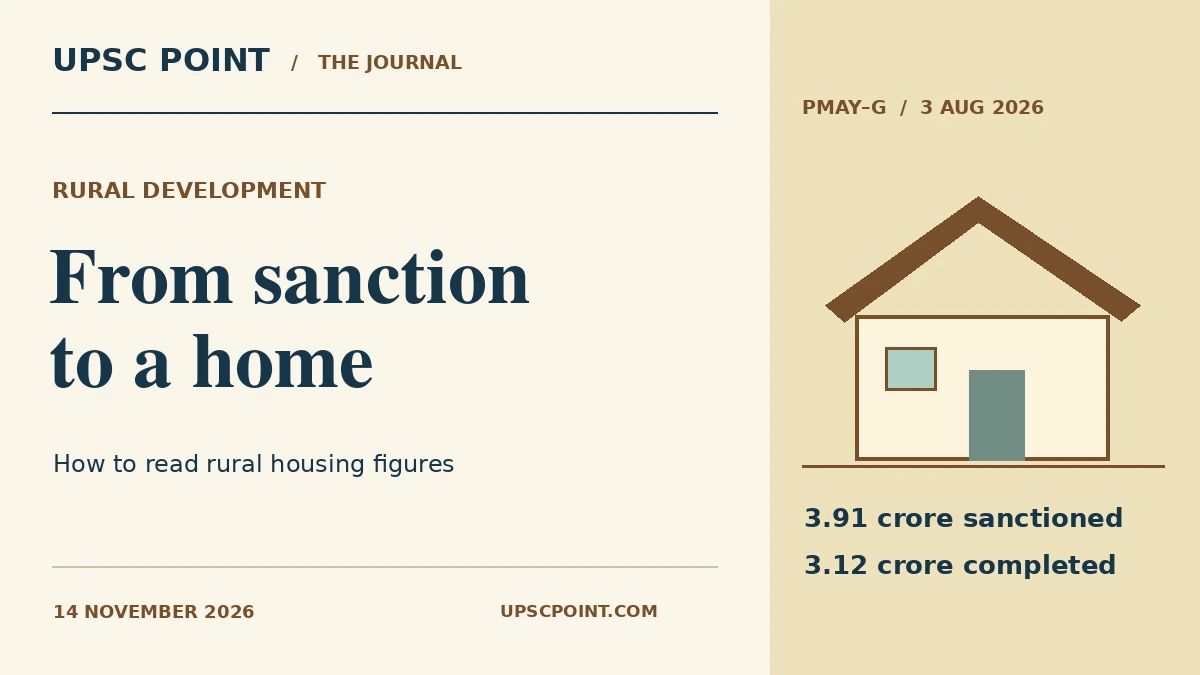
A village dashboard shows a house as sanctioned. The family may still be arranging materials or waiting for construction to begin. Under Pradhan Mantri Awaas Yojana–Gramin (PMAY-G), these stages answer different questions. Knowing which one you are looking at changes what you can conclude about delivery.
Explore this article Sections & revision ↓
How a household reaches the list
The rural housing scheme supports eligible households in building a pucca house. The Ministry of Rural Development describes a process that uses housing deprivation and exclusion criteria, verification of the priority list by Gram Sabhas, and an appeals process. Awaas+ helps identify additional households. The approved extension from 2024–25 to 2028–29 provides for assistance for two crore additional rural houses. [1]
Verification has a practical purpose. A survey may record the material of a dwelling accurately yet miss a household that formed after the survey. Local scrutiny can surface such a case. A review mechanism matters when a household disputes how the criteria were applied.
Read one official number carefully
On 3 August 2026, the ministry recorded 3.91 crore houses sanctioned and 3.12 crore completed. It described the remaining 79 lakh sanctioned houses as under construction. These are cumulative figures at one date. Reporting them as houses built in August would turn a stock into a monthly flow. [2]
Try the subtraction in the same unit. The difference of 0.79 crore is 79 lakh. An exam answer can use that figure to show work in progress. Inferring fraud or abandonment from the difference alone would require evidence the table does not provide.
What changes after sanction
Under PMAY-G the beneficiary constructs the house or supervises its construction. The ministry describes locally suitable designs and training for rural masons. [2] Imagine two households receiving approval on the same day. One can hire a mason immediately. The other must wait. The sanction dates match, but the construction timelines can differ.
A district review could therefore track waiting times at each stage and ask completed households about water access and usability. Construction records and residents’ experiences answer different parts of the housing question.
Read the dashboard like an examiner
Practice question: Which inference follows from the ministry’s 3 August figures? A. Every sanctioned house was occupied. B. Seventy-nine lakh households applied that month. C. Seventy-nine lakh sanctioned houses were under construction. D. Three crore houses were completed that financial year.
Answer C. Both counts refer to cumulative progress on the same date. For Mains, trace a household through selection, sanction and construction, then name one outcome you would check after a house is complete.
A framework to revise this issue
- 01Identify households
- 02Verify the list
- 03Sanction the house
- 04Track completion
| Concept or claim | What to examine |
|---|---|
| Target | The number assigned for programme delivery. |
| Sanction | Administrative approval for an individual house. |
| Completion | A house recorded as built. Occupancy is a separate question. |
A question to think through
How should a district assess whether a rural housing scheme has improved living conditions? Use PMAY-G to distinguish administrative progress from household outcomes. (150 words)
Build a position, explain its mechanism, consider a counterargument and propose a workable response.
Sources & further reading
Sources provide the factual anchors. The arguments and proposed evaluation frameworks are editorial analysis; illustrative scenarios are hypothetical.
- Ministry of Rural Development · Selection, Gram Sabha verification and extension of PMAY-G ↗
- Ministry of Rural Development · Parliamentary reply on PMAY-G progress, 7 August 2026 ↗
Found an error or a source that needs updating? Send the article title and the passage to our support team.