Kamarajar Port’s second terminal and the DBFOT model explained
Who pays for Kamarajar Port’s second container terminal? Understand DBFOT, dredging costs, TEUs and the 40-year concession through a UPSC infrastructure case.
GS III · Infrastructure, ports and investment models
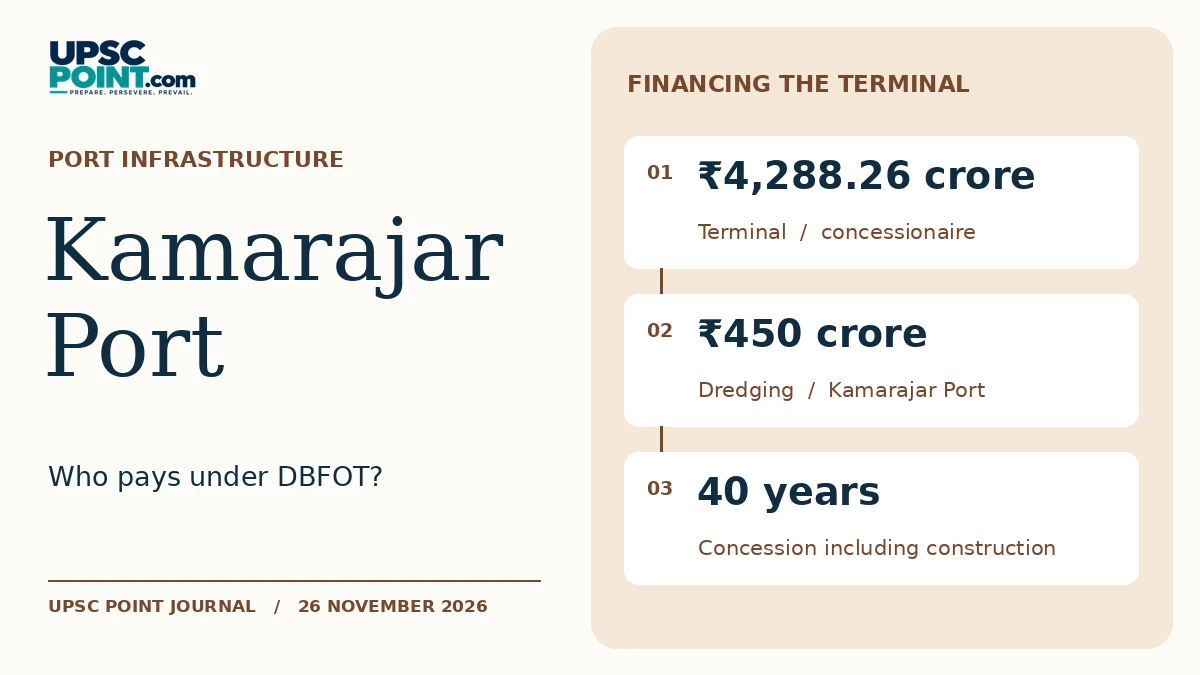
A private operator finances a terminal, yet the port company still pays for dredging. If you can explain that division, you can explain a public–private partnership more precisely than by saying that government and business ‘share the cost’. Kamarajar Port offers a case with published figures for each side.
Explore this article Sections & revision ↓
What did the Cabinet approve at Kamarajar Port?
On 25 November, the Cabinet Committee on Economic Affairs approved a second container terminal at Kamarajar Port in Tamil Nadu. The plan provides for 900 metres of quay, an 18-metre design draft and annual handling capacity of 2 million twenty-foot equivalent units (TEUs) across two phases. These are design specifications for an approved project. To establish actual throughput once the terminal opens, look at the port’s operating records. [1]
A TEU uses a twenty-foot container as a standard unit. In a simple example, ten twenty-foot containers and five forty-foot containers amount to twenty TEUs. This expresses container capacity in a common unit. It tells you neither how heavy the cargo is nor how long a ship waits for a berth.
Who finances what under DBFOT?
DBFOT stands for design, build, finance, operate and transfer. The selected concessionaire is to arrange the ₹4,288.26 crore investment in the terminal component, including GST. Kamarajar Port Limited has a separate estimated dredging responsibility of ₹450 crore. Listing these on different lines prevents the common error of calling the whole terminal cost a budget grant. [1]
The announced concession lasts 40 years, including 48 months for construction. User charges provide a route to recovering investment under the agreement and applicable tariff rules. A bid appraisal, Cabinet approval, award of the concession and commercial opening are separate events. The construction clock in the announcement runs from the award. [1][2]
How to evaluate the deal from a trader’s perspective
Suppose the new berth can service a larger vessel, but outbound containers still wait a day at the terminal gate. Installed capacity has risen while part of the logistics delay remains. Track vessel waiting time, container dwell time and inland travel time alongside annual TEUs handled. Each points to a different possible bottleneck.
In a Mains answer, assign risks to the party able to manage them. The operator can influence crane maintenance and staffing. Channel access depends partly on dredging, which the port company is to fund in this case. If dredging and equipment commissioning fall out of step, even a well-built berth may miss its target. Ask how the concession measures readiness and resolves delays. [1][2]
Prelims practice on the terminal concession
Practice question: Which statement correctly describes the approved Kamarajar terminal project?
A. The port company finances all terminal equipment. · B. Two million TEUs measures annual cargo weight. · C. Construction adds four years to a separate 40-year operating period. · D. The concessionaire finances the terminal component and KPL bears the separately estimated dredging cost.
Answer D. The Cabinet decision identifies the two responsibilities separately. TEUs measure container equivalents, and the 40-year concession includes the construction period. [1]
A framework to revise this issue
- 01Award the concession
- 02Design, finance and build
- 03Operate under the contract
- 04Transfer at concession end
| Concept or claim | What to examine |
|---|---|
| ₹4,288.26 crore | Estimated concessionaire-financed terminal component, including GST. |
| ₹450 crore | Dredging estimate to be borne separately by Kamarajar Port Limited. |
| 2 million TEUs a year | Planned handling capacity after both phases. Actual traffic will depend on demand and connectivity. |
A question to think through
How should India assess whether a port PPP reduces logistics costs for traders? Use Kamarajar Port to distinguish private and public responsibilities. (150 words)
Build a position, explain its mechanism, consider a counterargument and propose a workable response.
Sources & further reading
Sources provide the factual anchors. The arguments and proposed evaluation frameworks are editorial analysis; illustrative scenarios are hypothetical.
- Cabinet Committee on Economic Affairs · Approval of Kamarajar Port’s second container terminal ↗
- Department of Economic Affairs · PPP Appraisal Committee record for the Kamarajar terminal ↗
Found an error or a source that needs updating? Send the article title and the passage to our support team.