Electoral Finance in India: Transparency, Privacy and Voter Trust
How political funding affects democratic accountability, why disclosure needs usable data, and where donor privacy and fair electoral competition meet.
GS II · elections, transparency and accountability; GS IV · public integrity

A voter can compare speeches, manifestos and candidates. Understanding the financial relationships behind a campaign is harder. Money pays for legitimate political communication, but it can also create privileged access that remains invisible when citizens judge public decisions. The central question is not whether political parties need resources. They plainly do. It is how a democracy can finance political competition without making influence something citizens discover only after important choices have been made.
Explore this article Sections & revision ↓
Political money has more than one function
Campaigns require staff, travel, meeting spaces, communication and organisation between elections. A system that treats every donation as inherently suspicious risks confusing participation with corruption. Individuals and associations may legitimately support a political programme. The problem begins when the capacity to contribute becomes a hidden route to policy access, preferential treatment or protection from scrutiny.
There are therefore two separate tests. Was the donation legally collected and recorded? And does the overall financing system allow citizens to evaluate relationships between donors and decision makers? Passing the first test does not automatically satisfy the second. A bank transaction can be traceable to an authority while remaining opaque to voters, competitors and independent researchers.
What the electoral bonds judgment established
In its judgment of 15 February 2024, the Supreme Court held the Electoral Bond Scheme and associated non-disclosure provisions unconstitutional. Its official summary connects the decision to voters’ right to information and records the separate objection to unlimited corporate contributions. This is a dated constitutional anchor, not a claim about every subsequent financing arrangement. [1]
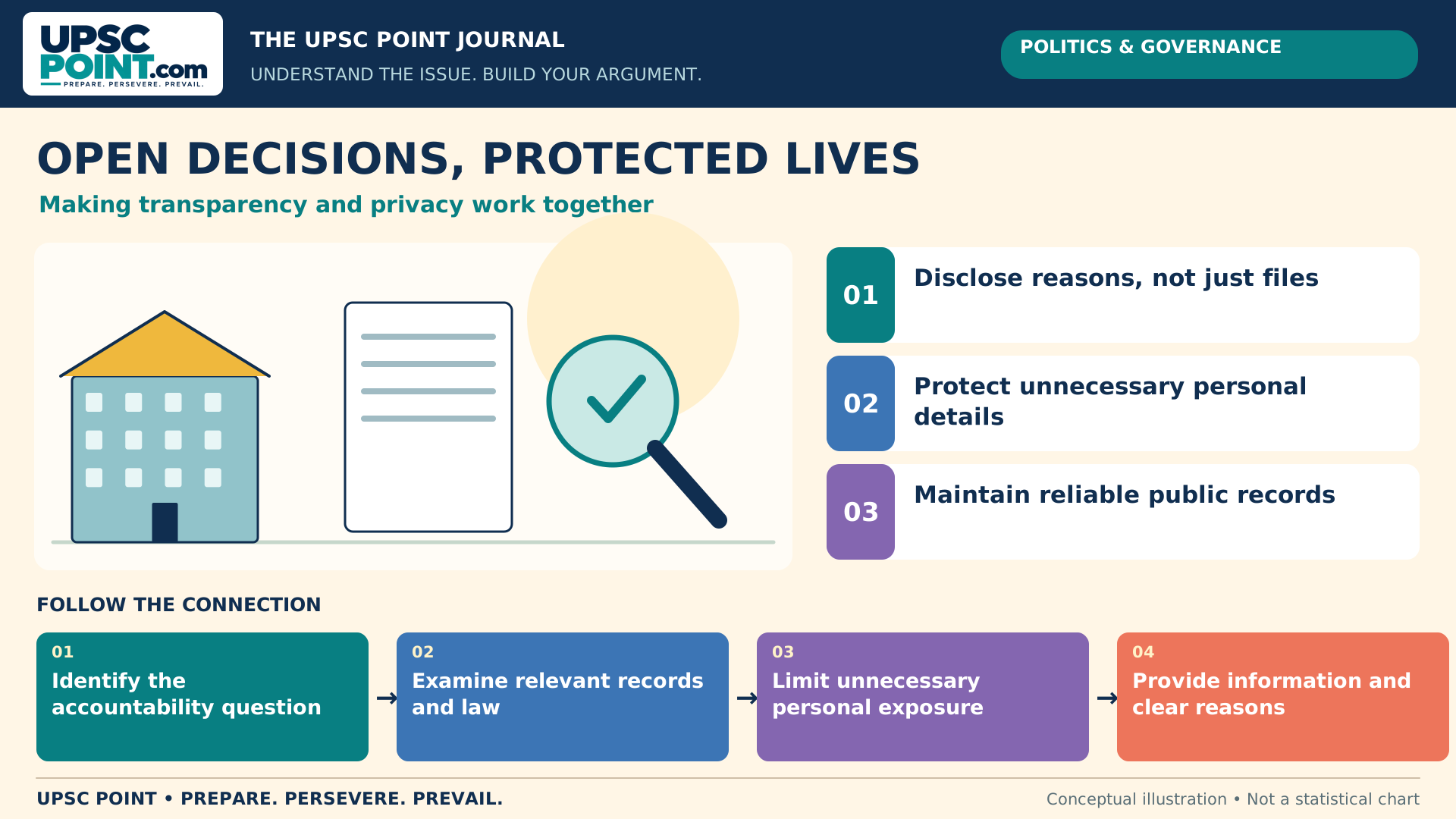
The wider institutional lesson is that formal banking channels and democratic transparency answer different questions. Banking records help identify a transaction within a regulated system. Public disclosure helps society examine who finances political organisations. A defensible reform must explain how it achieves both objectives while addressing genuine risks faced by people who participate in politics.
Disclosure must be possible to use
The Election Commission hosts electoral-bond purchase and redemption disclosures supplied by SBI in March 2024. Their existence illustrates why publication is an essential starting point. It does not mean that every relationship visible in financial records proves wrongdoing, nor that the records alone explain a policy decision. Interpretation requires dates, institutional context and corroborating evidence. [2]
For future disclosure design, searchable records, consistent identifiers, clear reporting periods and downloadable formats matter enormously. A scanned document technically available online may still impose substantial investigative costs. Missing explanations of corrections can make two legitimate versions appear contradictory. Transparency works better when ordinary readers can distinguish the original filing, a revised filing and the reason for revision.
A hypothetical donation is not proof of a bargain
Imagine a construction company donating to a party and later winning a public contract. The sequence creates a reasonable question, but not a complete answer. Was the tender competitive? Did the firm meet published criteria? Were rivals excluded without justification? Did the company also donate to other organisations? A responsible analysis investigates these links rather than treating timing as a verdict.
The opposite mistake is to dismiss every such question because the donation itself was lawful. Legality of payment cannot establish fairness of procurement. Financial disclosure becomes useful when combined with procurement records, conflict declarations and reasons for administrative decisions. Different datasets should illuminate one another without turning unverified suspicion into an allegation presented as fact.
Take donor privacy seriously without making power secret
A small contributor may fear workplace pressure, harassment or political retaliation. That concern deserves an answer beyond telling everyone to accept unlimited exposure. At the same time, large institutional donors can have a capacity to influence policy that differs substantially from a citizen making a modest contribution. Identical treatment may conceal important differences in power.
A policy discussion can therefore consider proportionate disclosure thresholds, safeguards against retaliation and scrutiny of aggregate funding patterns. These are design options, not assertions that a particular threshold currently applies. Any exemption needs protection against splitting large contributions into smaller payments. Privacy safeguards should protect vulnerable participation rather than become a convenient shelter for substantial, coordinated influence.
Fair competition involves spending as well as receipts
Knowing where money comes from leaves another question unanswered: how does it shape the competitive environment? A financially dominant organisation can communicate more frequently, employ better technology and sustain a larger local presence. None of these activities is automatically illegitimate. However, a democracy must examine whether financial advantages crowd out meaningful alternatives or distort citizens’ access to competing arguments.
Reform proposals should address reporting quality, independent monitoring and enforceable rules together. A nominally strict limit with weak detection can reward concealment. Public support for political activity may reduce dependence on wealthy donors, but its allocation can entrench established organisations if poorly designed. Fairness requires attention to entry barriers, not merely equal paperwork for unequal participants. Corporate funding also raises an internal accountability question: how are shareholders and other stakeholders informed about consequential political expenditure? Public transparency and organisational approval address different audiences. A coherent system should consider both, while avoiding the assumption that approval inside a company resolves the wider democratic concern.
Enforcement needs credibility and proportionality
Disclosure obligations lose force when false filings have no consequence or complaints remain unresolved indefinitely. Yet enforcement also becomes suspect if similar conduct attracts different responses depending on the organisation involved. Published standards, documented reasons and a meaningful opportunity to respond are necessary both for accountability and for confidence that oversight is not selective.
Useful measures include timeliness of filings, completeness of donor information, correction rates and resolution of substantiated discrepancies. These indicators should not be confused with a corruption index. More detected irregularities may initially reflect stronger oversight rather than worsening behaviour. Good evaluation asks what changed in detection and compliance before drawing a political conclusion from the headline number.
A reform package should follow the money through institutions
The practical objective is a chain of intelligible accountability: lawful receipt, reliable records, timely disclosure, independent examination and a proportionate response to proven violations. Break any link and the remaining parts become less useful. A magnificent public dashboard cannot compensate for incomplete source records, just as an audit report cannot help voters if it appears too late.
For a UPSC answer, organise the issue around participation, transparency, privacy, competition and enforcement. Explain the tension within each rather than merely listing reforms. The strongest conclusion is measured: political finance should make legitimate participation possible while allowing citizens to examine consequential relationships. Trust grows when the rules apply predictably and claims can be checked, not when every donor is presumed guilty.
A framework to revise this issue
- 01Political contribution
- 02Reliable financial record
- 03Usable public disclosure
- 04Independent scrutiny
| Concept or claim | What to examine |
|---|---|
| Banking traceability | Authorities can follow a transaction |
| Public transparency | Citizens can examine funding relationships |
| Proof of wrongdoing | Requires evidence beyond a donation |
A question to think through
Political finance reform must reconcile participation, donor privacy and the voter’s right to information. Discuss with reference to institutional design. (250 words)
Build a position, explain its mechanism, consider a counterargument and propose a workable response.
Sources & further reading
Sources provide the factual anchors. The arguments and proposed evaluation frameworks are editorial analysis; illustrative scenarios are hypothetical.
- Supreme Court: 2024 landmark judgment summaries ↗
- Election Commission: disclosure of electoral bonds ↗
Found an error or a source that needs updating? Send the article title and the passage to our support team.